
- Home
Edition
Africa Australia Brasil Canada Canada (français) Català España Europe France Global Indonesia New Zealand United Kingdom United States Skip to content Edition:
Global
Edition:
Global
- Africa
- Australia
- Brasil
- Canada
- Canada (français)
- Català
- España
- Europe
- France
- Indonesia
- New Zealand
- United Kingdom
- United States
Academic rigour, journalistic flair
 Members of The Bulletin of the Atomic Scientists reveal the Doomsday Clock, set to 85 seconds to midnight, during a news conference at the Carnegie Endowment for International Peace in January 2026 in Washington, D.C.
(AP Photo/Pablo Martinez Monsivais)
Why the Doomsday Clock has outlived its usefulness
Published: March 3, 2026 3.04pm GMT
Martin Hébert, Maxime Polleri, Université Laval
Members of The Bulletin of the Atomic Scientists reveal the Doomsday Clock, set to 85 seconds to midnight, during a news conference at the Carnegie Endowment for International Peace in January 2026 in Washington, D.C.
(AP Photo/Pablo Martinez Monsivais)
Why the Doomsday Clock has outlived its usefulness
Published: March 3, 2026 3.04pm GMT
Martin Hébert, Maxime Polleri, Université Laval
Authors
-
 Martin Hébert
Full Professor, Département d'anthropologie, Université Laval
-
Maxime Polleri
Assistant Professor, Anthropology, Université Laval
Disclosure statement
The authors do not work for, consult, own shares in or receive funding from any company or organisation that would benefit from this article, and have disclosed no relevant affiliations beyond their academic appointment.
Partners

Université Laval provides funding as a founding partner of The Conversation CA-FR.
Université Laval provides funding as a member of The Conversation CA.
View all partners
DOI
https://doi.org/10.64628/AAM.9uqcgyxg5
https://theconversation.com/why-the-doomsday-clock-has-outlived-its-usefulness-275409 https://theconversation.com/why-the-doomsday-clock-has-outlived-its-usefulness-275409 Link copied Share articleShare article
Copy link Email Bluesky Facebook WhatsApp Messenger LinkedIn X (Twitter)Print article
The Doomsday Clock — a symbolic device to signal an array of existential threats to the world since 1947 — was recently moved to 85 seconds before midnight, the closest it has ever been to midnight. And that was before all-out war broke out in Iran.
Created by the Bulletin of Atomic Scientists, the Doomsday Clock first represented a slow descent into nuclear vulnerability, with midnight standing as the nuclear apocalypse. Nowadays, the clock includes other existential threats to humanity, including global warming, disruptive technologies or the erosion of the rules-based international order.
Read more: Venezuela attack, Greenland threats and Gaza assault mark the collapse of international legal order
Mobilizing fear
Since its very beginning, the clock’s purpose was a call to action meant to shake world leaders — and the broader public by extension — awake from their complacency and indifference.
The aim of the Doomsday Clock was never to instil paralyzing anxiety. Quite the contrary, it sought to mobilize fear in a constructive way. It signals, implicitly, the hope that existential threats can be eradicated and the possibility that peril can be overcome, even if the odds are slim.
But over the years,, the Doomsday Clock has crept ever closer to midnight — first by minutes, then by seconds — heightening the sense of urgency while stopping short of the clock’s symbolic apocalypse.
Being mere seconds from catastrophe dramatically underscores the urgency of action, even as the shrinking margin to midnight heightens public anxiety.
We contend that this is the point where the narrative of imminent catastrophe becomes counter-productive: constant apocalyptic scenarios may dull perceptions of risk or be exploited to justify politics driven by urgency and fear.
Doomsday Clock flaws
The clock has long been subject to critics. Some have questioned its precision and called it showmanship. Others have described it as shaped by ideology.
But the first question we should ask of the Doomsday Clock is whether it fulfils its stated purpose: prompting transformative action to confront what are widely recognized as existential risks. It’s been argued that putting humanity on a permanent, blanket high alert isn’t helpful when it comes to formulating policy or driving science.
The narratives of nuclear war and impending apocalypse that underpin the Doomsday Clock have historically been used to project authority and justify dangerous politics of secrecy — legacies that have often come at the expense of public health and well-being.
For instance, during the Cold War, the U.S. strategically stoked a sense of urgency within its population against the potential threat of nuclear war with the Soviet Union.
During that time, education often blended with propaganda as schoolchildren were told to prepare themselves against potential nuclear attacks, learning from Bert the Turtle to “duck and cover.”
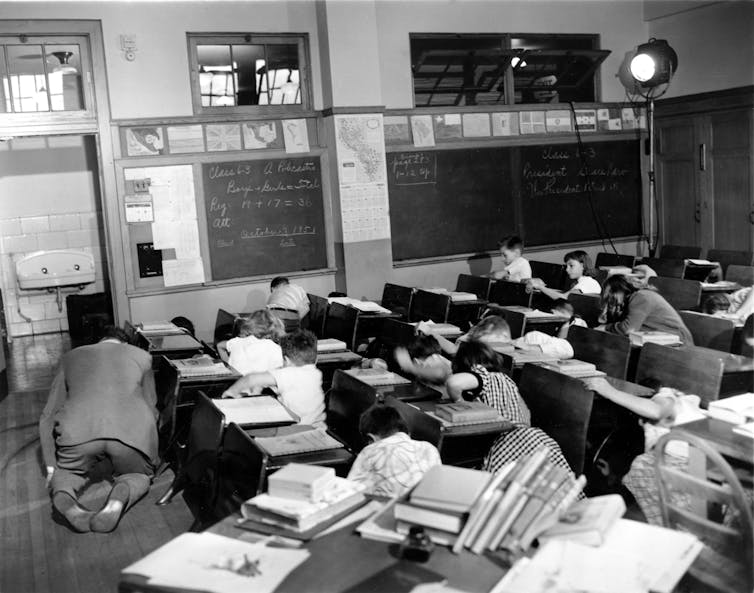 Sixth grade students crouch under or beside their desks along with their teacher in November 1951 in an elementary school in Queens, New York City.
(AP Photo/Dan Grossi)
Sixth grade students crouch under or beside their desks along with their teacher in November 1951 in an elementary school in Queens, New York City.
(AP Photo/Dan Grossi)
Worried citizens built bunkers in their homes as billions of dollars were pumped into the military industrial complex.
Those who criticized such preparedness measures faced accusation of anti-patriotism or of being communists underMcCarthyism and the Red Scare.
In the end, the sense of a looming apocalypse sacrificed the social and national security of Americans for a threat that never materialized. Ironically, in being fearful of being bombed, Americans exposed their own population to dangerous radioactive fallouts and material via nuclear tests and arsenal production.
How we define disaster
Obviously, complacency about the serious challenges the world is facing is not an option. But the idea that we are almost at the point of no return via the Doomsday Clock is no longer useful or helpful.
This is especially the case since the doom symbolized by the clock has become more abstract with time. Since it’s broadened beyond nuclear war, the clock struck midnight a long time ago for many people on the planet.
Recognizing the difference in experiences among privileged groups, for whom catastrophe remains a future prospect, and marginalized groups, who live in what has been described as a world of salvage, should prompt us to rethink how we measure and define impending disaster.
By calibrating the Doomsday Clock in ever-narrowing seconds, we construct an imaginative framework in which meaningful change is equated with turning the clock back. It may be more honest — and more useful — to acknowledge that we’re already living at the brink.
Read more: How the Doomsday Clock could help trigger the armageddon it warns of
As militarism and fascism surged in 1935, Dutch cultural historian Johan Huizinga could have said Europe stood seconds from catastrophe. Instead, he took a different view: “We all know that there is no way back, that we have to fight our way through.”
The uncertainty and anxiety produced by being “seconds to midnight” via the Doomsday Clock can upset the balance between fear and hope. It risks normalizing the violence long endured by racialized and marginalized communities, while creating fertile ground for either opportunistic politics or irrational faith that events will simply resolve themselves.
At this point, action is stalled by the stubborn conviction that this cannot really be happening to us. Perhaps this is when the clock should strike 12 — not as an endpoint, but as a signal that the focus must shift from prevention to another mode of response. In many areas of life, acknowledging that a crisis has arrived is the first step toward recovery.
- Climate change
- Cold War
- Fear
- Doomsday Clock
- Existential despair
Events
Jobs
-
 Learning Designer
-
Simulation Education Manager and Facilitator
-
Visiting Professor - 2027 Australia-Korea Chair in Australian Studies at Seoul National University
-
Department Chair and Associate Professor/Professor of Media and Communication
-
1 year editorial cadetship
 Learning Designer
 Simulation Education Manager and Facilitator
 Visiting Professor - 2027 Australia-Korea Chair in Australian Studies at Seoul National University
 Department Chair and Associate Professor/Professor of Media and Communication
 1 year editorial cadetship
- Editorial Policies
- Community standards
- Republishing guidelines
- Analytics
- Our feeds
- Get newsletter
- Who we are
- Our charter
- Our team
- Partners and funders
- Resource for media
- Contact us
-
-
-
-
Copyright © 2010–2026, The Conversation