- Home
Edition
Africa Australia Brasil Canada Canada (français) Català España Europe France Global Indonesia New Zealand United Kingdom United States Skip to content Edition:
Global
Edition:
Global
- Africa
- Australia
- Brasil
- Canada
- Canada (français)
- Català
- España
- Europe
- France
- Indonesia
- New Zealand
- United Kingdom
- United States
Academic rigour, journalistic flair
 RubinObs/NSF/DOE/NOIRLab/SLAC/AURA/T. Lange
World’s biggest astronomy camera seeks to answer pressing questions about the universe
Published: March 3, 2026 4.51pm GMT
Joshua Weston, Queen's University Belfast
RubinObs/NSF/DOE/NOIRLab/SLAC/AURA/T. Lange
World’s biggest astronomy camera seeks to answer pressing questions about the universe
Published: March 3, 2026 4.51pm GMT
Joshua Weston, Queen's University Belfast
Author
-
 Joshua Weston
PhD Candidate, School of Mathematics and Physics, Queen's University Belfast
Disclosure statement
Joshua Weston does not work for, consult, own shares in or receive funding from any company or organisation that would benefit from this article, and has disclosed no relevant affiliations beyond their academic appointment.
Partners

Queen's University Belfast provides funding as a founding partner of The Conversation UK.
View all partners
DOI
https://doi.org/10.64628/AB.c95ffk67h
https://theconversation.com/worlds-biggest-astronomy-camera-seeks-to-answer-pressing-questions-about-the-universe-277017 https://theconversation.com/worlds-biggest-astronomy-camera-seeks-to-answer-pressing-questions-about-the-universe-277017 Link copied Share articleShare article
Copy link Email Bluesky Facebook WhatsApp Messenger LinkedIn X (Twitter)Print article
The Vera C. Rubin Observatory has started releasing its first discoveries: including supernovae, variable stars and asteroids, which will from now on be discovered at an astonishing rate as it begins its Legacy Survey of Space and Time, a ten-year survey probing the deepest reaches of the universe.
During the course of this survey, astronomers around the globe will seek to answer some of the most pressing questions about the nature of our world.
To the naked eye, the night sky seems like a static and unchanging firmament, with the occasional planet or comet or shooting star visible.
But with a larger, more sophisticated telescope or camera we are able to discover hundreds of new phenomena every night, from dying stars to near-Earth asteroids.
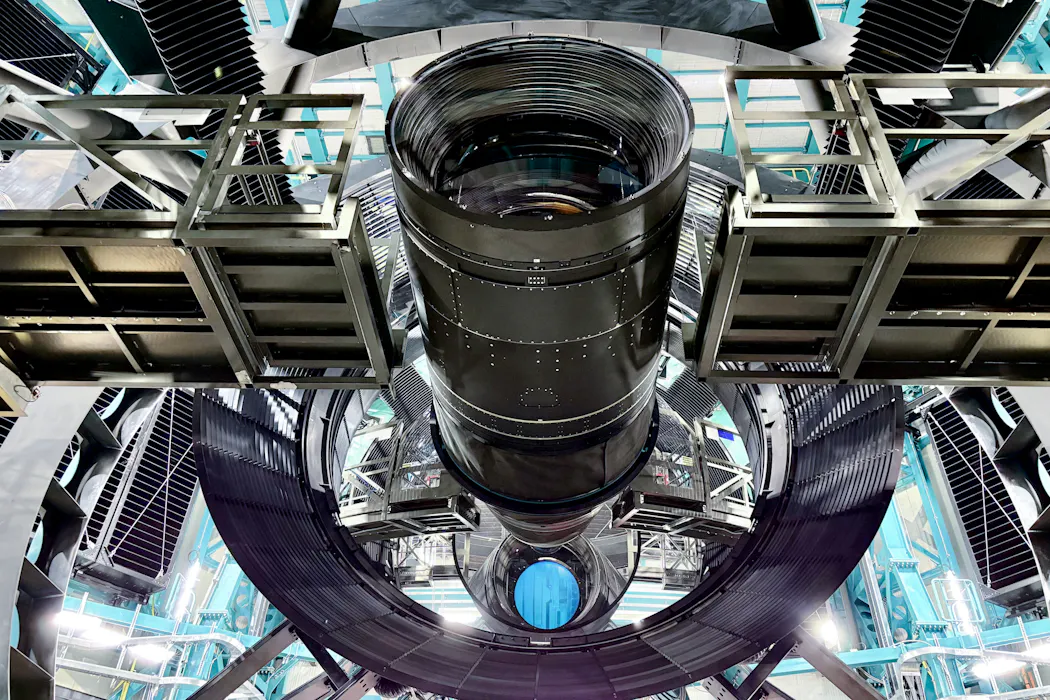
The camera that allows this exploration – attached to a telescope over eight metres wide atop Cerro Pachón in Chile – is the largest in the world, weighing almost three tonnes and built over ten years.
The Rubin Observatory’s giant camera can probe the faintest reaches of our existence, capturing light emitted as much as 12 billion years ago. But the Rubin camera will capture new events much closer to our Solar System.
By taking multiple photographs of the sky every night – and tracking any differences between them, scientists will be able to capture objects moving through space such as the tens of millions of asteroids and comets hurtling through the Solar System.
Outer reaches
Increasing the number of known asteroids in the belt between Mars and Jupiter can help us to understand the formation history of the Solar System.
Beyond Neptune in the faint and distant Kuiper Belt – a population of icy objects in the outer reaches of the Solar System – astronomers will be able to study an environment similar to our Solar System in its infancy, to better understand how we came to be.
It has been theorised before that disturbances to the orbits of Kuiper Belt objects indicates the existence of a hypothesised “planet nine” – Rubin may even be able to build more evidence for this as-yet undiscovered world.
Beyond the solar system, astronomers seek to identify stellar streams of stars leftover from smaller galaxies merging with our own, which help us understand the history of the Milky Way.
What Rubin will capture more than any previous telescope are optical transients – stars brightening and dimming, and those that eventually explode as a supernova.
These explosions produce elements essential to life, from oxygen to iron, and scatter across the universe the materials required for forming stars and planets.
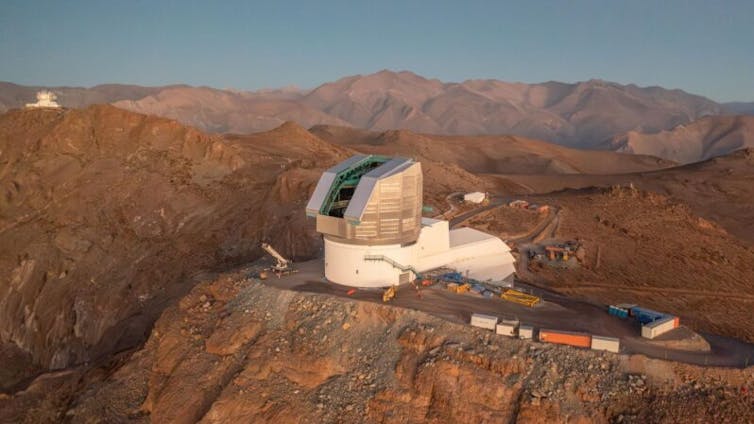 The Vera C. Rubin Observatory will carry out a ten-year survey of the Universe.
Rubin Observatory
The Vera C. Rubin Observatory will carry out a ten-year survey of the Universe.
Rubin Observatory
Capturing more of these supernovae and understanding how they happen is vital for understanding the evolution of the universe. While these are some of the more common “flashes” Rubin will find in its game of spot-the-difference, other rarer objects such as black holes will also be detected and studied to improve our understanding of cosmology.
Some supernovae can be used to determine how far away the galaxy they inhabit is, letting us discover new environments from the earliest years of the universe. Why is it important to capture data about these ancient galaxies?
Scientists believe that the universe after the Big Bang was uniform in all directions. How then did galaxies form? Astronomers believe the answer lies in small clumps of dark matter, which gas and dust gravitated around until galaxies could be born.
The issue with dark matter is that we cannot observe it directly, though it makes up 80% of matter in the universe. The dark matter is responsible for galaxies – and everything within them – developing, but it also forms even larger-scale filaments of galaxies.
How these structures form is dependent on what dark matter is – which requires us to know how it influenced the formation of galaxies big and small, old and young.
Understanding existence
The Legacy Survey of Space and Time seeks to answer one question – what is the universe? It also prompts another – why does it matter? By understanding where our existence comes from, we can predict the nature and eventual evolution of the universe: a complete picture of cosmic evolution from start to finish.
Humanity has turned to a number of answers for its own existence over the course of its existence, with Rubin another step in the direction of finally getting the full picture.
Understanding the fundamental forces at work in our universe is a path to answering many of the spiritual questions of society (what are we here for?) but also the practical ones (what steps do we take now?).
The Legacy Survey of Space and Time has inspired collaboration from scientists across the world based in countries such as Chile, the US, France, Germany, Australia, Japan, Brazil and the UK.
Techniques in machine learning and AI to analyse the huge amounts of data generated by Rubin will have uses in industries such as finance, medicine and engineering.
Regardless of how Rubin furthers our understanding of the universe, it will still enable technological innovations and international collaboration.
- Astronomy
- Vera C Rubin Observatory
Events
Jobs
-
 Learning Designer
-
Simulation Education Manager and Facilitator
-
Visiting Professor - 2027 Australia-Korea Chair in Australian Studies at Seoul National University
-
Department Chair and Associate Professor/Professor of Media and Communication
-
1 year editorial cadetship
 Learning Designer
 Simulation Education Manager and Facilitator
 Visiting Professor - 2027 Australia-Korea Chair in Australian Studies at Seoul National University
 Department Chair and Associate Professor/Professor of Media and Communication
 1 year editorial cadetship
- Editorial Policies
- Community standards
- Republishing guidelines
- Analytics
- Our feeds
- Get newsletter
- Who we are
- Our charter
- Our team
- Partners and funders
- Resource for media
- Contact us
-
-
-
-
Copyright © 2010–2026, The Conversation