
- Home
Edition
Africa Australia Brasil Canada Canada (français) Català España Europe France Global Indonesia New Zealand United Kingdom United States Skip to content Edition:
Global
Edition:
Global
- Africa
- Australia
- Brasil
- Canada
- Canada (français)
- Català
- España
- Europe
- France
- Indonesia
- New Zealand
- United Kingdom
- United States
Academic rigour, journalistic flair
 Cells for battery manufacturing wait to be assembled into modules at a lithium-ion battery manufacturing facility in Mirabel, Que., in September 2023.
THE CANADIAN PRESS/Christinne Muschi
Why the U.S. is unlikely to curtail China’s dominance over critical minerals
Published: March 3, 2026 6.31pm GMT
Craig Anthony Johnson, University of Guelph
Cells for battery manufacturing wait to be assembled into modules at a lithium-ion battery manufacturing facility in Mirabel, Que., in September 2023.
THE CANADIAN PRESS/Christinne Muschi
Why the U.S. is unlikely to curtail China’s dominance over critical minerals
Published: March 3, 2026 6.31pm GMT
Craig Anthony Johnson, University of Guelph
Author
-
 Craig Anthony Johnson
Professor of Politics, University of Guelph
Disclosure statement
Craig Anthony Johnson receives funding from the Social Sciences and Humanities Research Council of Canada.
Partners

University of Guelph provides funding as a founding partner of The Conversation CA.
University of Guelph provides funding as a member of The Conversation CA-FR.
View all partners
DOI
https://doi.org/10.64628/AAM.w5t3ccsus
https://theconversation.com/why-the-u-s-is-unlikely-to-curtail-chinas-dominance-over-critical-minerals-275416 https://theconversation.com/why-the-u-s-is-unlikely-to-curtail-chinas-dominance-over-critical-minerals-275416 Link copied Share articleShare article
Copy link Email Bluesky Facebook WhatsApp Messenger LinkedIn X (Twitter)Print article
The United States government recently hosted a critical minerals summit aimed at reducing China’s predominant role in the global production of smartphones, weapons systems, lithium-ion batteries and electric vehicles (EVs).
The meeting, which included representatives from Argentina, Australia, Bolivia, Canada, Chile, the Democratic Republic of Congo, India, the European Union, Japan, South Korea and the United Kingdom, is part of a larger structural trend that Canadian Prime Minister Mark Carney recently called a “rupture” to the rules-based international order.
At first glance, the U.S. government’s weaponization of tariffs and trade indicate changing dynamics in global trade and the development of critical minerals, advanced manufacturing and emerging technologies. On closer inspection, American efforts to weaken China’s dominance over the critical minerals industry face a more complicated reality and an intricate web of public- and private-sector investment agreements tied to Chinese firms.
According to the International Energy Agency, China accounts for more than 80 per cent of global battery production. The figure jumps to 90 per cent for grid scale batteries that are used to store wind and solar power.
Global battery sales have grown sixfold since 2020, a direct result of falling prices and the competitiveness of China’s low-cost manufacturing model. Over the same period, manufacturing of grid-scale battery systems has expanded 20-fold.
Within this reality, the idea that the U.S. can strategically reduce China’s role in the production and processing of critical minerals appears highly unlikely.
Competition for critical minerals
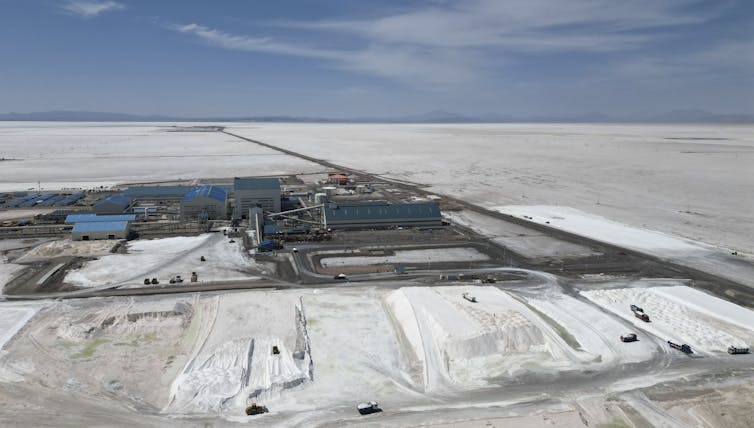 An industrial plant to produce lithium carbonate, used to manufacture lithium batteries, stands after its opening ceremony in the Uyuni salt desert on the outskirts of Llipi, Bolivia, in December 2023.
(AP Photo/Juan Karita)
An industrial plant to produce lithium carbonate, used to manufacture lithium batteries, stands after its opening ceremony in the Uyuni salt desert on the outskirts of Llipi, Bolivia, in December 2023.
(AP Photo/Juan Karita)
My research focuses on environmental politics, extractive industries and the expansion of renewable energy value chains in Latin America. I am currently leading a study on the politics of lithium extraction in Argentina, Australia, Bolivia, Canada and Chile.
Over the past year, the U.S. upped its efforts to reduce China’s involvement in South America, a region that accounts for more than 50 per cent of the world’s known lithium deposits.
In 2025, the U.S. government acquired a five per cent share in Lithium Americas, a Canada-based company that has a long presence in Argentina. In February, the U.S. government announced another deal to acquire a 10 per cent stake in the mining company USA Rare Earth.
In 2025, the White House used the threat of tariffs and a US$20 billion bailout package to negotiate a new trade agreement with Argentina. Meanwhile, the U.S.-dominated Inter-American Development Bank signed an agreement to provide more than US$140 million to improve critical mineral production and processing capacity in Latin America.
However, decoupling China from regional production networks raises deeper questions about whether it makes good business or strategic sense to disrupt a global production network that produces 80-90 per cent of the world’s lithium-ion batteries.
At a time when the U.S. is pursuing an “America first” policy of onshoring the production and processing of critical minerals, China has used joint ventures and public-private partnerships to secure access while offshoring the dirtier parts of critical minerals production.
The Chinese company Ganfeng Lithium has been active in Argentina for about a decade and is currently expanding its presence through joint ventures.
In August 2025, the company signed joint ventures with Canadian company Lithium Americas, expanding its operations in the salt flats of Pozuelos, Pastos Grandes and Cauchari-Olaroz. The vast majority of Ganfeng’s production goes to battery and EV assembly hubs in China and Southeast Asia.
In contrast, China’s involvement in Chile has largely been limited to a minority share in the Chilean mining company SQM since 2018. Under the left-wing government of Gabriel Boric, Chile’s National Lithium Strategy promised to restrict new licences to state-owned copper and mining companies Codelco and Enami.
However, the recent electoral victory of President-elect José Antonio Kast, a right-wing politician with close ties to Chile’s business sector, raises new questions about the future viability of the nationalist policy.
Similarly, questions have been raised about whether the Bolivian government will maintain its state-led model of resource nationalism under the newly elected right-wing government of Rodrigo Paz Pereira.
Chinese and Russian companies have a strong presence in Bolivia. In 2024, the majority state-owned lithium company, YLB, signed a US$1 billion agreement with the Chinese consortium CBC to start developing the Uyuni salt flat. But Bolivia’s lithium production has remained negligible, reflecting longstanding challenges of extracting lithium from the Uyuni salt flat and resolving domestic conflicts over the distribution of profits.
Looking ahead
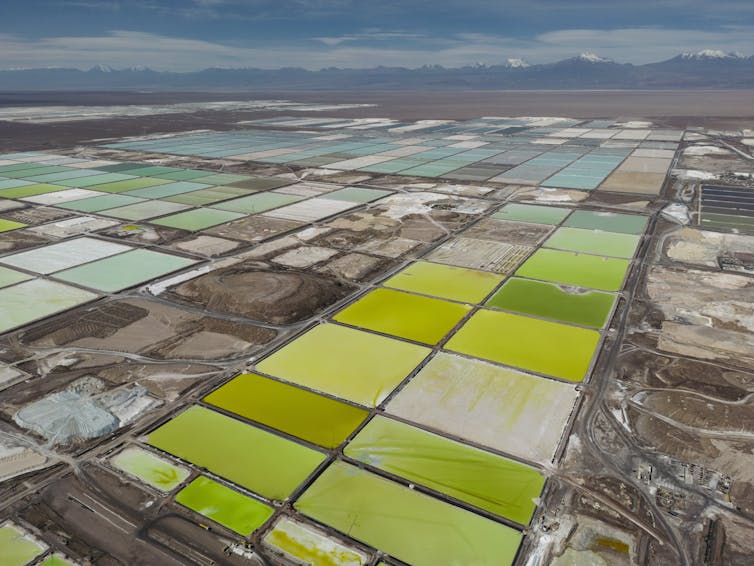 An aerial view of pools of brine that slowly turned into lithium in the SQM mine in the San Pedro de Atacama desert, in northern Chile, in April 2023.
(AP Photo/Rodrigo Abd)
An aerial view of pools of brine that slowly turned into lithium in the SQM mine in the San Pedro de Atacama desert, in northern Chile, in April 2023.
(AP Photo/Rodrigo Abd)
In theory, the election of right-wing governments in Argentina, Bolivia and Chile should favour the U.S. This is most evident in Argentina, where libertarian president Javier Milei has already established strong ties with the White House and with U.S. President Donald Trump personally.
Compared with Argentina, Chile appears less likely to concede to American concerns about China. This reflects the Chilean state’s dominant role in the global copper market, domestic conflicts over the nationalization of Chile’s lithium sector and the enduring influence of Chinese political and diplomatic interests.
Looking ahead, major questions remain about whether American companies have the willingness and capacity to assume China’s role in the global production of lithium-ion batteries and whether they’ll align themselves with U.S. foreign policy interests. For instance, the U.S.-based Albemarle Corporation is one of the world’s largest lithium companies, but it is publicly traded and owned by multiple investors.
Outside of South America, global lithium production remains dominated by American, Chinese and Australian firms, including Rio Tinto, the Anglo-Australian mining giant that is currently consolidating lithium operations in Argentina and Chile. Almost all have joint ventures with Tianqi, Ganfeng and other Chinese companies.
The North American economy has neither the capacity nor the wage competitiveness to replace China’s role in producing and processing critical minerals for batteries, energy storage systems and EVs.
Reducing China’s dominant role in the global critical minerals industry would entail developing a robust supply chain that can out-compete China’s. Given current economic and geopolitical realities, this seems improbable in the foreseeable future.
- Lithium
- Argentina
- Latin America
- Chile
- Bolivia
- US-China
- Critical minerals
Events
Jobs
-
 Learning Designer
-
Simulation Education Manager and Facilitator
-
Visiting Professor - 2027 Australia-Korea Chair in Australian Studies at Seoul National University
-
Department Chair and Associate Professor/Professor of Media and Communication
-
1 year editorial cadetship
 Learning Designer
 Simulation Education Manager and Facilitator
 Visiting Professor - 2027 Australia-Korea Chair in Australian Studies at Seoul National University
 Department Chair and Associate Professor/Professor of Media and Communication
 1 year editorial cadetship
- Editorial Policies
- Community standards
- Republishing guidelines
- Analytics
- Our feeds
- Get newsletter
- Who we are
- Our charter
- Our team
- Partners and funders
- Resource for media
- Contact us
-
-
-
-
Copyright © 2010–2026, The Conversation