
- Home
Edition
Africa Australia Brasil Canada Canada (français) Català España Europe France Global Indonesia New Zealand United Kingdom United States Skip to content Edition:
Global
Edition:
Global
- Africa
- Australia
- Brasil
- Canada
- Canada (français)
- Català
- España
- Europe
- France
- Indonesia
- New Zealand
- United Kingdom
- United States
Academic rigour, journalistic flair
 A black plume of smoke rises from a warehouse at the industrial area of Sharjah in the United Arab Emirates following reports of Iranian strikes in neighbouring Dubai, on March 1, 2026.
(AP Photo/Altaf Qadri)
Iran’s missile mayhem show the limits of Middle East defences
Published: March 3, 2026 8.17pm GMT
Michael J. Armstrong, Brock University
A black plume of smoke rises from a warehouse at the industrial area of Sharjah in the United Arab Emirates following reports of Iranian strikes in neighbouring Dubai, on March 1, 2026.
(AP Photo/Altaf Qadri)
Iran’s missile mayhem show the limits of Middle East defences
Published: March 3, 2026 8.17pm GMT
Michael J. Armstrong, Brock University
Author
-
 Michael J. Armstrong
Associate Professor, Operations Research, Brock University
Disclosure statement
Michael J. Armstrong does not work for, consult, own shares in or receive funding from any company or organisation that would benefit from this article, and has disclosed no relevant affiliations beyond their academic appointment.
Partners

Brock University provides funding as a member of The Conversation CA-FR.
Brock University provides funding as a member of The Conversation CA.
View all partners
DOI
https://doi.org/10.64628/AAM.u7n676vvk
https://theconversation.com/irans-missile-mayhem-show-the-limits-of-middle-east-defences-277211 https://theconversation.com/irans-missile-mayhem-show-the-limits-of-middle-east-defences-277211 Link copied Share articleShare article
Copy link Email Bluesky Facebook WhatsApp Messenger LinkedIn X (Twitter)Print article
The Israeli Operation Roaring Lion and the American Operation Epic Fury started early on Feb. 28 when both countries began attacking Iran. Their airstrikes killed Iran’s leader, Ayatollah Ali Khamenei, while striking military targets and cities across the country. More than 700 people have reportedly been killed in the attacks so far, including children at a girls’ school.
Iran responded with its own Operation True Promise 4 missile and drone strikes against Israeli and American targets. But it also started bombarding nine other Middle East countries. Iran’s attacks to date have killed six U.S. soldiers, 10 civilians in Israel and about 10 more in Arab countries.
Iran’s allies have joined the fighting. Hezbollah forces in Lebanon and Iranian-backed militants in Iraq have launched their own rockets, while Houthi militants in Yemen have threated to enter the fray too.
Iran’s counterattacks might appear strategically reckless. But they’re sowing chaos across the region and revealing the limits of their neighbour’s defences.
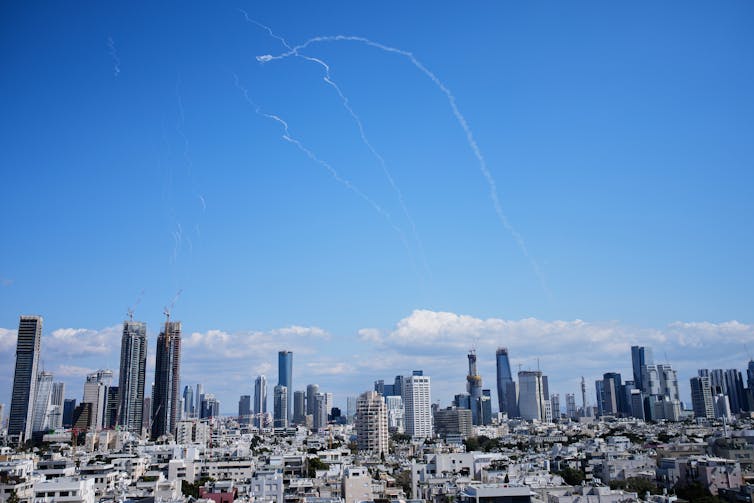 Israeli air defence system fires to intercept missiles during an Iranian attack over central Israel on March 1, 2026.
(AP Photo/Ohad Zwigenberg)
Israeli air defence system fires to intercept missiles during an Iranian attack over central Israel on March 1, 2026.
(AP Photo/Ohad Zwigenberg)
Israel’s defences under strain
Israel has sophisticated missile defences and ample operational experience. Its Iron Dome short-range rocket interceptors entered service in 2011. The medium-range David’s Sling and long-range Arrow interceptors followed.
Its newest weapon is a laser system. Iron Beam saw its first combat use last year against drones and small rockets.
But interceptors aren’t foolproof, and they sometimes fail.
Iran’s newest weapons aggravate this problem. Some missiles reportedly carry dozens of small explosives instead of one big one. These little bomblets disperse while falling from the sky to complicate interception.
Israel has warning systems and bomb shelters to protect civilians from nearby explosions, but some residents lack immediate access to shelters. One woman died on Feb. 28 when a missile landed near her building before she could take cover.
Additionally, some older shelters were designed only to withstand smaller rockets. On March 1, a ballistic missile with a 500-kilogram warhead directly hit a shelter, killing nine people inside.
Spillover into Arab states
Iran’s Arab neighbours are accustomed to being bystanders during Israel-Iran conflicts. This time, however, Iran is attacking them too.
Jordan, Iraq, Kuwait, Saudi Arabia, Bahrain, Qatar, the United Arab Emirates and Oman have all been assaulted by Iranian weapons. Some 282 missiles and 833 drones attacked those countries over the weekend, and the barrage remains ongoing.
Even a British airbase in Cyprus, far away in the Mediterranean, has been struck.
Iran claims it’s only targeting U.S. forces stationed in those countries. However, airports, hotels, apartment buildings and oil tankers have also been hit. Oman had recently hosted U.S.-Iran peace talks, and last week announced that peace was “within reach.”
Most of the countries have U.S.-made Patriot interceptor systems to defend against such attacks, but they lack Israel’s operational experience. The U.S. also has Patriot and THAAD interceptors in the region.
In one case, three U.S. Patriot air defence missiles failed to intercept an incoming Iranian ballistic missile warhead, which reportedly struck Al Udeid Air Base in Qatar. And Kuwaiti air defences accidentally shot down three U.S. fighter jets.
Three U.S. Patriot air defence missiles (rising from bottom of screen) fail to stop an incoming Iranian ballistic missile warhead (descending from upper right).Costly choices
Economic costs are growing too. With oil and gas refineries closing, and tanker traffic through the Strait of Hormuz halted, global oil prices have jumped.
Read more: What is the Strait of Hormuz, and why does its closure matter so much to the global economy?
Iran’s attacks beyond Israel have also prompted more countries to oppose it. Qatar shot down two Iranian fighter jets on March 2 and Britain has begun allowing U.S. airstrikes from British airbases. France is sending air defences to Cyprus and Ukraine is sending drone experts to Arab countries.
An uncertain future
It’s difficult to predict how long the attacks will continue. Iran is believed to have around 2,500 ballistic missiles stockpiled, including 1,000 that could strike Israel or perhaps Europe. Its drone supply is likely larger, meaning launches could continue for months.
U.S. and Israeli warplanes are actively hunting Iranian missile launchers, but past conflicts show airstrikes alone have little impact on launch rates. Those drop only if ground invasions occur.
It’s likewise unclear how long the American-Israeli bombing campaign will last. U.S. President Donald Trump has suggested four to five weeks, maybe longer.
However, the U.S. military will likely start running out of interceptor missiles in four weeks. Qatar reportedly has only enough for four days.
Trump’s warplanes will probably run out of high-priority targets even sooner.
Trump’s political end game
The greatest uncertainty right now concerns Trump and his motives, as his war goals appear to keep shifting.
He has called for the Iranian people to “seize control” of their “destiny.” But Secretary of War Pete Hegseth has said the operation is not intended to cause regime change.
Such a regime change is unlikely. Trump’s January attack on Venezuela merely captured the country’s president and left the rest of the regime in place. He showed more interest in Venezuela’s oil than its governance.
America’s previous regime change in Iran also didn’t end well. In 1953, the U.S. Central Intelligence Agency incited a coup that removed Iran’s elected government and replaced it with a military regime that was friendly to U.S. but unpopular in Iran. In 1979, a revolt ended the dictatorship and installed the current Islamic Republic.
Trump has often favoured transactional diplomatic deals in the past. Whether this conflict moves toward escalation or negotiation remains unclear, but it’s likely he’ll seek do something similar here.
What is clear is that the longer the conflict continues, the greater the human and economic costs are likely to be.
- United States
- Israel
- Middle East
- War
- Iran
- Missiles
- Missile defence
- US-Iran
- US-Iran conflict
Events
Jobs
-
 Learning Designer
-
Simulation Education Manager and Facilitator
-
Visiting Professor - 2027 Australia-Korea Chair in Australian Studies at Seoul National University
-
Department Chair and Associate Professor/Professor of Media and Communication
-
1 year editorial cadetship
 Learning Designer
 Simulation Education Manager and Facilitator
 Visiting Professor - 2027 Australia-Korea Chair in Australian Studies at Seoul National University
 Department Chair and Associate Professor/Professor of Media and Communication
 1 year editorial cadetship
- Editorial Policies
- Community standards
- Republishing guidelines
- Analytics
- Our feeds
- Get newsletter
- Who we are
- Our charter
- Our team
- Partners and funders
- Resource for media
- Contact us
-
-
-
-
Copyright © 2010–2026, The Conversation