- News
Asian shares have resumed their decline after a global sell-off for stocks hit Wall Street, while oil prices climbed even higher
Elaine Kurtenbach Wednesday 04 March 2026 02:49 GMT- Bookmark
Bookmark popover
Removed from bookmarks
Close popoverAsian shares extend losses as the war with Iran widens and oil surges higher
Show all 5



For free real time breaking news alerts sent straight to your inbox sign up to our breaking news emails
Sign up to our free breaking news emails
Sign up to our free breaking news emails
Email*SIGN UPI would like to be emailed about offers, events and updates from The Independent. Read our Privacy notice
Asian shares fell further on Wednesday after the global sell-off for stocks hit Wall Street, while oil prices climbed even higher.
Worries over the widening war with Iran have hammered most world markets. Higher oil prices and how much they might worsen inflation are among the central fears for investors. More spikes for oil prices may grind down the global economy and sap corporate profits.
South Korea's Kospi led regional losses, plunging 6% to 5,447.52 as energy security concerns vanquished optimism over the boost big tech companies like Samsung Electronics and SK Hynix are getting from expanding use of artificial intelligence.
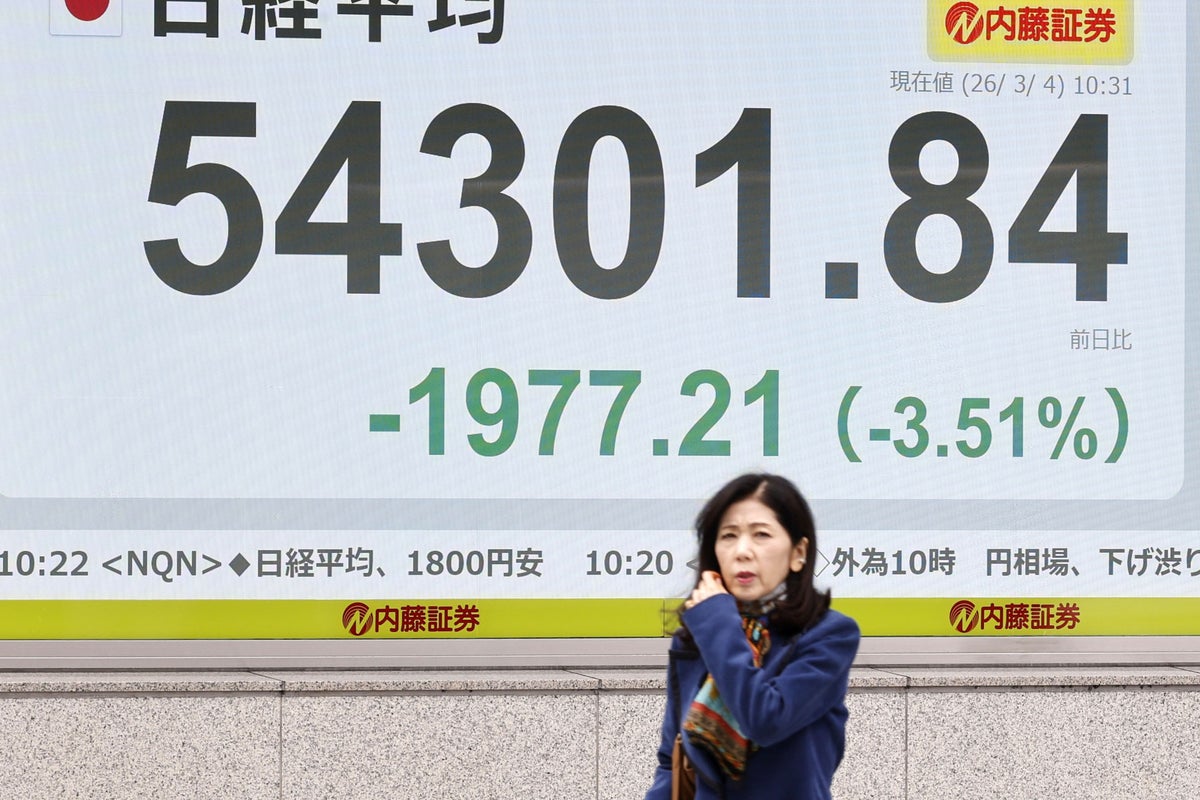
In Tokyo, the Nikkei 225 shed 3.4% to 54,346.73. Japan, like South Korea, depends heavily on imports of oil and natural gas from the Middle East that are now stranded in the Persian Gulf.
Elsewhere in Asia, the Hang Seng in Hong Kong fell 1.4% to 25,408.27 and the Shanghai Composite index was down 0.5% at 4,100.46.
In Australia, the S&P/ASX 200 declined 1.8% to 9,130.90.
Taiwan's Taiex lost 2.9%.
On Tuesday, the S&P 500 finished with a loss of 0.9% after dropping as much as 2.5% on concerns over the war’s damage to the economy. The Dow Jones Industrial Average pared its loss to 0.8%, and the Nasdaq composite fell 1%.
Higher inflation partly due to the war could tie the Federal Reserve’s hands and keep it from cutting interest rates. The Fed lowered rates several times last year and indicated more cuts were to come in 2026. That would help boost the economy and job market, but lower rates can also worsen inflation.
The price of U.S. benchmark crude oil climbed 1.2% to $75.46 per barrel. Brent crude, the international standard, gained 1.5% to $82.61 per barrel.
The dollar was nearly unchanged at 157.55 Japanese yen. The euro slipped to $1.1599 from $1.600.