
- Pro
How will AI evolve in 2026?
When you purchase through links on our site, we may earn an affiliate commission. Here’s how it works.
 Image credit: geralt on Pixabay
(Image credit: Pixabay)
Image credit: geralt on Pixabay
(Image credit: Pixabay)
- Copy link
- X
- Threads
Sign up for breaking news, reviews, opinion, top tech deals, and more.
Contact me with news and offers from other Future brands Receive email from us on behalf of our trusted partners or sponsors By submitting your information you agree to the Terms & Conditions and Privacy Policy and are aged 16 or over.You are now subscribed
Your newsletter sign-up was successful
An account already exists for this email address, please log in. Subscribe to our newsletterIn 2025, AI crossed an important threshold. After years of experimentation, generative AI moved decisively into enterprise workflows, while agentic systems and long-term memory capabilities began to take shape in real-world deployments.
Sarah HoffmanSocial Links NavigationDirector of AI Thought Leadership, AlphaSense.
As a result, current AI conversations aren’t focused on hype, but by pragmatism. Leaders are shifting their focus from what AI can do in theory to what it should do in practice.
You may like-
 5 AI predictions for 2026
-
 Why 2026 is the year AI finally understands the work behind the work
-
 Five AI agent predictions for 2026: The year enterprises stop waiting and start winning
From reactive to proactive AI
One of the most important shifts underway is AI’s move from reactive to proactive decision making. With long-term memory capabilities now firmly established, AI systems will increasingly anticipate user needs instead of waiting for explicit instructions.
Early signs of this transition are already visible. ChatGPT Pulse, for example, now conducts research for users based on prior interactions without requiring a prompt. In July 2025, leaked documents revealed that Meta was training its chatbots to proactively message users, following up on earlier conversations without being asked.
While this shift promises gains in productivity and speed, it will also introduce new friction. As AI acts autonomously, deciding when to engage rather than waiting to be summoned, users will need to recalibrate their expectations and trust in these systems.
Users must be conscious of bias amplification and potential privacy erosion. Expect both enthusiasm and skepticism as proactive AI becomes more commonplace.
Are you a pro? Subscribe to our newsletterContact me with news and offers from other Future brandsReceive email from us on behalf of our trusted partners or sponsorsBy submitting your information you agree to the Terms & Conditions and Privacy Policy and are aged 16 or over.The rise of invisible intelligence
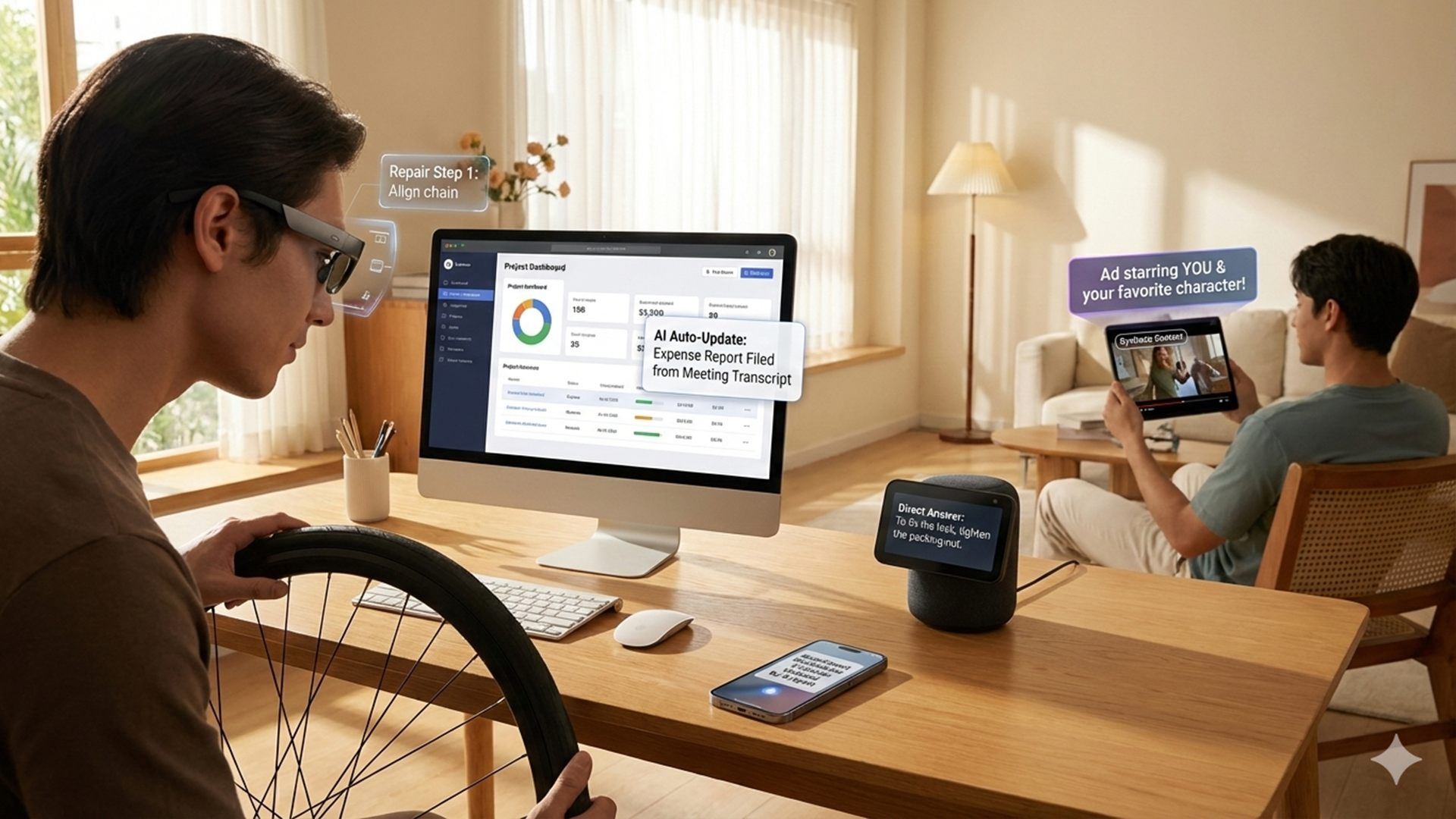
Before the surge in generative AI, existing AI systems had already become largely invisible.
For example, tools like Waze dynamically rerouting drivers based on traffic patterns or Amazon surfacing product recommendations, delivered clear value without drawing attention to the underlying technology powering them. Users benefited from AI without consciously engaging with it.
Generative AI reversed that dynamic. By shifting intelligence to be conversational and explicit, tools like ChatGPT reintroduced visibility, prompting users to actively seek out AI for help. That visibility, however, will not remain the norm.
You may like-
5 AI predictions for 2026
-
Why 2026 is the year AI finally understands the work behind the work
-
Five AI agent predictions for 2026: The year enterprises stop waiting and start winning
Generative AI is increasingly fading into the background, becoming embedded across products, services, and interfaces in ways that feel natural rather than novel.
Simply adding generative AI is not enough. The most successful platforms will be those where AI is seamlessly integrated, enhancing experiences quietly and continuously, rather than announcing its presence.
From scale to specialization
2025 showed that scale alone no longer drives large breakthroughs. GPT-5, for example, delivered only incremental gains over OpenAI’s previous model. Against this backdrop, specialization is emerging as the more durable path forward.
Today, the hardest problems in applied AI are about trust, domain understanding, evaluation, and integration into existing workflows. Addressing those challenges increasingly requires focusing on data, constraints, and workflows specific to a given domain.
Industry-specific and use-case-driven solutions will proliferate as organizations seek accuracy, reliability, and domain expertise rather than generalized capability.
Speaking at Davos in January, Microsoft CEO Satya Nadella warned that AI could still become a bubble if its benefits fail to spread broadly across industries and economies.
Early examples of this shift are already emerging. Anthropic’s launch of Claude for Life Sciences in October 2025 marked an early milestone. The tool is designed to support researchers in accelerating discoveries, with a long-term ambition of enabling AI to independently generate scientific breakthroughs.
In January 2026, OpenAI launched ChatGPT Health, a sandboxed tab within ChatGPT designed for users to ask their health-related questions in a more secure and personalized environment.
Rather than pouring resources exclusively into ever-larger, general-purpose systems, leading AI companies will invest in specialized AI systems. These tailored systems not only improve accuracy, but also build trust, accelerate ROI and align more closely with regulatory requirements.
AI’s reality check
As the industry moves beyond the hype cycle, AI is entering a more disciplined phase. Investment decisions are shifting from sweeping promises to measurable business impact, with organizations finally holding AI to the same rigorous standards as any other enterprise tool.
While the underlying tech continues to dazzle, the novelty of "talking to a machine" is fading. The coming year will be defined by integration over innovation, where the best technology is the kind we stop noticing because it simply works.
We've featured the best AI website builder.
This article was produced as part of TechRadarPro's Expert Insights channel where we feature the best and brightest minds in the technology industry today. The views expressed here are those of the author and are not necessarily those of TechRadarPro or Future plc. If you are interested in contributing find out more here: https://www.techradar.com/news/submit-your-story-to-techradar-pro
TOPICS AI Sarah HoffmanSocial Links NavigationDirector of Research, AI at AlphaSense.
View MoreYou must confirm your public display name before commenting
Please logout and then login again, you will then be prompted to enter your display name.
Logout Read more
5 AI predictions for 2026
Why 2026 is the year AI finally understands the work behind the work
Five AI agent predictions for 2026: The year enterprises stop waiting and start winning
 Nano Banana blew up, agents fell short – here’s the full AI story from 2025
 ChatGPT, Gemini, and Claude predict AI's future
 'It's time to demand AI that is safe by design': What AI experts think will matter most in 2026
Latest in Pro
'It's time to demand AI that is safe by design': What AI experts think will matter most in 2026
Latest in Pro
 “AI in networks isn’t CPU vs. GPU”: Intel unveils 18A-based Clearwater Forest Xeon 6+ for edge AI and early 6G infrastructure
 No, the sub-$500 PC market will not disappear by 2028 - Au contraire, I expect it to thrive. Here's why
 ‘I can think of a couple Pretti Good reasons!’: Hacktivists may have just cracked open ICE and exposed over 6,000 companies working with the DHS
 This new phishing campaign uses a fake Google Account security page to steal passcodes and more
 Microsoft warns of OAuth phishing campaigns able to bypass email and browser defenses - says 'these campaigns demonstrate that this abuse is operational, not theoretical'
 Stripe wants to help your business claim back all those AI costs
Latest in Opinion
Stripe wants to help your business claim back all those AI costs
Latest in Opinion
 I can't believe I'm saying this, but a more expensive MacBook Air M5 is wonderful news — here's why
2025 was the year AI grew up. How will AI evolve in 2026?
I can't believe I'm saying this, but a more expensive MacBook Air M5 is wonderful news — here's why
2025 was the year AI grew up. How will AI evolve in 2026?
 AI conversations at Davos have sprinted ahead – we need to go back to basics
 The agentic future: Why AI's greatest power is amplifying human potential
 Samsung Galaxy S26 Ultra's Privacy Display could hold a social problem
 Anthropic’s CEO isn’t sure if Claude AI is conscious.
LATEST ARTICLES
Anthropic’s CEO isn’t sure if Claude AI is conscious.
LATEST ARTICLES- 1Google patches 129 Android security flaws — including a potentially dangerous Qualcomm zero-day
- 2I can't believe I'm saying this, but a more expensive MacBook Air M5 is wonderful news — here's why
- 3Pokémon Pokopia is the highest-rated Pokémon game since X/Y on Metacritic, and it's not even out on Nintendo Switch 2 yet
- 4“AI in networks isn’t CPU vs. GPU”: Intel unveils 18A-based Clearwater Forest Xeon 6+ for edge AI and early 6G infrastructure
- 5After more than eight months with the Nintendo Switch 2, I still can’t get over this one performance upgrade — and it's got nothing to do with visuals or framerate