- Home
Edition
Africa Australia Brasil Canada Canada (français) España Europe France Global Indonesia New Zealand United Kingdom United States Edition:
Global
Edition:
Global
- Africa
- Australia
- Brasil
- Canada
- Canada (français)
- España
- Europe
- France
- Indonesia
- New Zealand
- United Kingdom
- United States
Academic rigour, journalistic flair
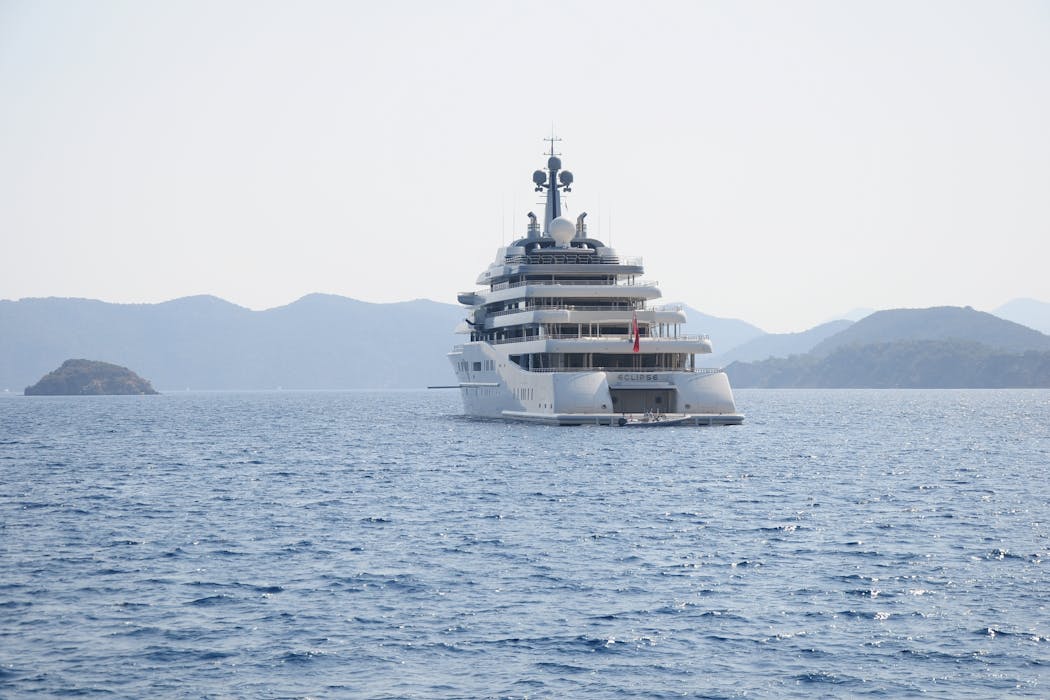
 Roman Abramovich’s super-yacht Eclipse.
Bulent Demir/Shutterstock
The politics of the hyper-polluting private transport used by the world’s super-rich is hotting up
Published: December 23, 2025 3.55pm GMT
Rowland Atkinson, University of Sheffield
Roman Abramovich’s super-yacht Eclipse.
Bulent Demir/Shutterstock
The politics of the hyper-polluting private transport used by the world’s super-rich is hotting up
Published: December 23, 2025 3.55pm GMT
Rowland Atkinson, University of Sheffield
Author
-
 Rowland Atkinson
Professor and Research Chair in Inclusive Societies, University of Sheffield
Disclosure statement
Rowland Atkinson does not work for, consult, own shares in or receive funding from any company or organisation that would benefit from this article, and has disclosed no relevant affiliations beyond their academic appointment.
Partners

University of Sheffield provides funding as a founding partner of The Conversation UK.
View all partners
DOI
https://doi.org/10.64628/AB.7g4fyahut
https://theconversation.com/the-politics-of-the-hyper-polluting-private-transport-used-by-the-worlds-super-rich-is-hotting-up-270343 https://theconversation.com/the-politics-of-the-hyper-polluting-private-transport-used-by-the-worlds-super-rich-is-hotting-up-270343 Link copied Share articleShare article
Copy link Email Bluesky Facebook WhatsApp Messenger LinkedIn X (Twitter)Print article
While millions of people make the effort to sort their recycling, buy fewer clothes and generally make greener choices, the world’s wealthiest can emit the same amount of carbon as the average person does in a year by going on holiday just once.
Among the many things worrying the climate-conscious is the question of the carbon-intensive movements of the super-rich – classed as those with more than US$30 million (£23 million) in disposable assets. This phenomenon, characterised by the use of private jets, fossil-fuelled yachts, heavy cars and space rockets, represents an enormous, and unnecessary, environmental impact.
It is estimated that the 125 wealthiest billionaires alone emit three million tonnes of carbon annually. This is close to the carbon footprint of Madagascar, a country of 30 million people.
Recent attention on the super-emitters has focused on jets, but private super-yachts are also major contributors. Despite their names, these vessels lack sails and require gigalitres of fuel to transport only a small number of crew and passengers.
Large yachts can consume hundreds of litres of fuel per hour, while super-yachts may use thousands of litres per hour even when just cruising. Yacht engines must “idle” at anchor to maintain heating and energy systems, consuming thousands of litres per week.
The yacht owned by former Chelsea FC owner Roman Abramovich, Eclipse, reportedly has a 1,000,000-litre fuel tank, while Google’s Sergey Brin’s super-yacht uses enough power to supply 580 homes, even when it is simply moored in port.
The emerging trend of private rockets also involves burning vast quantities of fuel – with no current limits on use. Former Amazon CEO Jeff Bezos’ first trip to the edge of the atmosphere reportedly produced around 93 metric tons of CO².
It has been calculated that there are 41.3 million high net worth individuals in the world, and, within this group, 510,000 ultra-high net worth individuals. Together, they are thought to possess liquid wealth of nearly US$60 trillion.
More money, more travel
This growth in private wealth has directly translated into an increase in jets and yachts and their use over time. For example, the global private super-yacht fleet has grown by 50% in about ten years and continues to see strong demand. The number of private jets has also increased substantially, leading to greater use and expansion of ground facilities at numerous airports.
The data shows the massive carbon footprints associated with the most luxurious (and unnecessary) forms of mobility utilised by the world’s wealthiest people. While many may scoff at the prospect of a human exit to Mars, this does not prevent a ramping-up of exploratory and carbon-intensive trial flights in pursuit of this mission.
Compared to the essential carbon emitted by everyday citizens going about their work and lives, the contrast is stark. It highlights how luxury and entitlement combine to create a new class of hyper-mobile carbon-emitting groups.
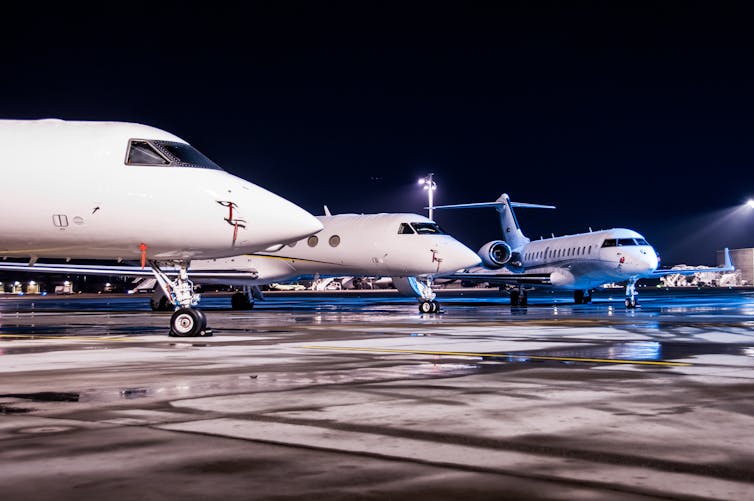 The proliferation of private jets is creating a new class of hypermobility.
Thierry Weber/Shutterstock
The proliferation of private jets is creating a new class of hypermobility.
Thierry Weber/Shutterstock
The expansion of the super-rich and their carbon footprint poses significant challenges to curbing emissions and fostering social unity. Inequality threatens social cohesion and has undermined the effectiveness of the political sphere, both of which are crucial for climate action.
The primary “winners” in the global political economy have been positioned as legitimate users of private jets by the aero industry on the basis that they save time that is critical to business activity. But it seems that something else is blocking action, given how publicly unpopular the use of private jets by the rich has become.
In 2024 Oxfam reported that 80% of the public support higher passenger duties on private jets and yachts. Another survey the same year showed that more than 40% of people in six European nations (UK, Germany, France, Spain, the Netherlands and Belgium) supported an outright ban on the use of private jets.
It is increasingly clear that the global climate emergency outweighs the need for “Instagram sunsets” of private super-yacht and jet users in public opinion. For brave leaders, there could be real political capital to be gained from reducing this mobility as feelings run high over waste, pollution and emissions.
Social cohesion and collective action are necessary to reduce emissions. But efforts to discourage unnecessary mobility will be challenged by powerful voices celebrating choice, individual freedoms to move and consume, and life experiences that entail massive carbon costs. The planet cannot support this outdated growth and status-conscious economic model – it must be challenged for all our sakes.
- Climate change
- Super rich
- high net worth individuals
- Give me perspective
- Private jets
Events
Jobs
-
 Lecturer/Senior Lecturer, Terrestrial Ecology
-
Video producer
-
Manager, Intellectual Property Commercialisation
-
Research Assistant, Quantum-enabled super-resolution imaging
-
Lecturer (Education Focused)
 Lecturer/Senior Lecturer, Terrestrial Ecology
 Video producer
 Manager, Intellectual Property Commercialisation
 Research Assistant, Quantum-enabled super-resolution imaging
 Lecturer (Education Focused)
- Editorial Policies
- Community standards
- Republishing guidelines
- Analytics
- Our feeds
- Get newsletter
- Who we are
- Our charter
- Our team
- Partners and funders
- Resource for media
- Contact us
-
-
-
-
Copyright © 2010–2025, The Conversation