
- Home
Edition
Africa Australia Brasil Canada Canada (français) España Europe France Global Indonesia New Zealand United Kingdom United States Edition:
Global
Edition:
Global
- Africa
- Australia
- Brasil
- Canada
- Canada (français)
- España
- Europe
- France
- Indonesia
- New Zealand
- United Kingdom
- United States
Academic rigour, journalistic flair
 Joe Forget/Unsplash
The macabre imagination and erratic life of the man behind Christmas story The Nutcracker
Published: December 21, 2025 7.09pm GMT
Eric Parisot, Flinders University
Joe Forget/Unsplash
The macabre imagination and erratic life of the man behind Christmas story The Nutcracker
Published: December 21, 2025 7.09pm GMT
Eric Parisot, Flinders University
Author
-
 Eric Parisot
Associate Professor in English Literature, Flinders University
Disclosure statement
Eric Parisot does not work for, consult, own shares in or receive funding from any company or organisation that would benefit from this article, and has disclosed no relevant affiliations beyond their academic appointment.
Partners

Flinders University provides funding as a member of The Conversation AU.
View all partners
DOI
https://doi.org/10.64628/AA.uu3wap5r4
https://theconversation.com/the-macabre-imagination-and-erratic-life-of-the-man-behind-christmas-story-the-nutcracker-268889 https://theconversation.com/the-macabre-imagination-and-erratic-life-of-the-man-behind-christmas-story-the-nutcracker-268889 Link copied Share articleShare article
Copy link Email Bluesky Facebook WhatsApp Messenger LinkedIn X (Twitter)Print article
It’s that time of year when our favourite Christmas stories reemerge to dominate the stage and screen. Prominent among them is The Nutcracker, a classic 19th-century tale that has been adapted in a variety of forms, but is best known as Tchaikovsky’s 1892 ballet.
Not many would know E.T.A. Hoffmann as the author of the original story, The Nutcracker and the Mouse King (1816), in which a child’s Christmas present comes to life. Even fewer would know much about him.
It is fair to say he is not the kind of writer some might imagine to be behind the delightful children’s fantasy of tin soldiers, armies of mice and sugar plum fairies.
 Image from the first Russian production of Tchaikovsky’s ballet The Nutcracker (1892).
Public domain, via Wikimedia Commons
Image from the first Russian production of Tchaikovsky’s ballet The Nutcracker (1892).
Public domain, via Wikimedia Commons
Who was E.T.A. Hoffmann?
Hoffmann was a German Romantic author of unnerving fairy tales and macabre fantasies.
He was born on January 24, 1776, in Königsberg (now Kaliningrad, Russia) and baptised Ernst Theodor Wilhelm Hoffmann. He later substituted Amadeus for Wilhelm out of admiration for Mozart.
Hoffmann had a troubled childhood that, some propose, left an enduring imprint on his art. His parents, unhappily married, had three sons. One died in infancy. The other was taken away by Hoffmann’s father when his parents separated in 1779. Hoffmann never saw his father or brother again. Critic Jack Zipes – who labels Hoffmann a “wounded storyteller” – suggests we can see Hoffmann’s absent father in many of his haunting tales.
Hoffmann was raised in his mother’s family home, under the stifling influence of the Doerffer family. His mother, suffering from chronic depression, relinquished his care to Hoffmann’s grandmother. His aunts and uncle took great pains to ensure that their nephew grew to be a solid member of the bourgeoisie. He was well versed in music; his modes of dress, speech and behaviour were heavily monitored.
Tellingly, Hoffmann broke all ties with the Doerffer family in 1800, when he passed law examinations with honours and was assigned to Posen, Poland, as a state official.
 E.T.A. Hoffmann (c.1800)
Public domain, via Wikimedia Commons
E.T.A. Hoffmann (c.1800)
Public domain, via Wikimedia Commons
Hoffmann’s tales often rail against social and intellectual conformity, or what fellow Romantic William Blake called the “mind-forg’d manacles” of oppressive social and political systems. Hoffmann’s formative years with the Doerffer family may well have inspired this Romantic rebellion.
A difficulty to conform also permeates Hoffmann’s patchy professional life. In 1802, he lost his post in Posen after he caused trouble with some comical sketches of aristocratic Prussian officers.
In 1808, disillusioned, he looked to forge a musical career, becoming a tutor and the director of the music theatre in Bamberg, Germany, which now bears his name. Local infamy soon forced the itinerant Hoffmann to move again after he scandalously became obsessed with one of his students, the 13-year-old Julia Marc. In 1813, he became a conductor for an opera company in Leipzig and Dresden, where he completed his only opera, Undine.
 E.T.A. Hoffmann’s illustration for an 1816 edition of his story The Nutcracker and the Mouse King.
Public domain, via Wikimedia Commons
E.T.A. Hoffmann’s illustration for an 1816 edition of his story The Nutcracker and the Mouse King.
Public domain, via Wikimedia Commons
While pursuing his professional music career, Hoffman began to write fiction. His first short story, The Knight Gluck, was published in 1809. His first collection of stories, Fantasy Pieces, followed in 1814.
In Berlin, after further professional disagreements forced Hoffman and his wife to move again in 1814, Hoffman discovered how favourably his fairy tales and short stories had been received across Germany.
He dedicated the remaining eight years of his life to writing, moving in literary circles, while holding various musical and legal posts. He died in 1822, aged 46, from atrophy of the liver and subsequent paralysis.
Hoffmann’s posthumous reputation was not forgiving. He was framed as erratic and deranged by his biographer and good friend Julius Eduard Hitzig. Even his death was shrouded in scandal. Rumours of syphilis as the result of a supposedly sexually promiscuous life persist in modern criticism.
A warped imagination
As is the case with Edgar Allan Poe’s popular image as a drug-addicted maniac, the image of Hoffman as an unconventional and mad anarchist is, no doubt, fuelled by the stories that emerged from his bizarre creative mind.
A central theme of his stories is the unsettling tension between adherence to arbitrary social laws and traditions, and the dreamlike freedom of the imagination. His weird tales often bring alternate realities into conflict, leaving his protagonists temporarily or permanently disordered.
In his first story – The Knight Gluck – Hoffmann offers one of the first literary portrayals of the doppelgänger, a supernatural double. In this tale, the narrator and the strange man he meets are ultimately revealed to be the same. The Knight Gluck foreshadows more renowned stories, such as Poe’s William Wilson (1839) and Fyodor Dostoevsky’s The Double (1846).
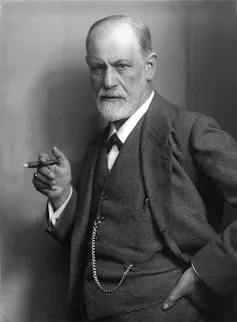 Sigmund Freud, photograph by Max Halberstadt (c.1921)
Public domain, via Wikimedia Commons
Sigmund Freud, photograph by Max Halberstadt (c.1921)
Public domain, via Wikimedia Commons
Readers of Sigmund Freud will also recognise Hoffmann as the author of The Sandman (1816), the short story Freud analyses to elucidate his theory of the uncanny. It is also the first story dramatised in Jacques Offenbach’s opera, Tales of Hoffmann, first staged in 1851.
In his essay The Uncanny (1919), Freud describes the uncanny as an eerie feeling that comes when something is unnervingly both familiar and unfamiliar — heimlich and unheimlich. He cites déjà vu, doppelgängers and inanimate objects coming to life as manifestations of the uncanny.
The Sandman offers an example of the latter. Among other strange events, the protagonist’s love for an automaton drives him towards madness and suicide. It is a tale that calls into question our privileging of the physical senses, but one that also warns against obsession with imagined fantasy. It also, incidentally, inspired another popular ballet: Leo Delibes’ Coppélia (1870).
The Steel Tree
So how does The Nutcracker and the Mouse King fit into this strange body of work?
Hoffmann’s original tale is no innocent sugarcoated fantasy. The story was written for his friend Hitzig’s children, Marie and Fritz. It is a veiled critique of the strictures Hitzig and his social class placed on his children’s freedom.
The story is, tellingly, set in a household named Stahlbaum, or “Steel Tree”: a fortress of sorts that is infiltrated by the mysterious Drosselmeier.
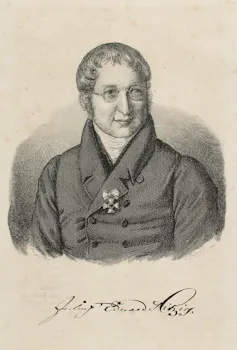 Julius Eduard Hitzig – Joseph Leudner (1841)
Public domain, via Wikimedia Commons
Julius Eduard Hitzig – Joseph Leudner (1841)
Public domain, via Wikimedia Commons
In Hoffmann’s tale, Marie is positioned as the novice who must learn to use and trust her imagination. Only her imaginative vision can animate – literally and metaphysically – the mundane world that surrounds her and fulfil her dreams and desires. Drosselmeier is a figure analogous to Hoffmann, cultivating Marie Hitzig’s imagination within and outside of the story.
This clashing of worlds is not without its trauma. Hoffmann’s story ends on a sombre note, with Marie’s visions being dismissed by her family as nonsense. Mocked into outward submission, she never speaks of these adventures again. Ridiculed as a dreamer, she becomes reserved. But in her mind’s eye, she returns from time to time to “those glorious days”.
Hoffmann’s ending leaves us suspended between sadness at the suppression of Marie’s childhood imagination and triumph at the quiet persistence of her imaginative spirit.
From page to stage
Alexandre Dumas, the famed French author of swashbuckling adventures, such as The Three Musketeers (1844), The Count of Monte Cristo (1846) and The Man in the Iron Mask (1848–50), was an admirer of Hoffmann. In 1845, he published a translation of Hoffmann’s story, retitled The Tale of the Nutcracker.
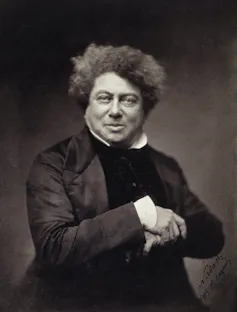 Alexandre Dumas (c. 1855)
Public domain, via Wikimedia Commons
Alexandre Dumas (c. 1855)
Public domain, via Wikimedia Commons
Dumas was not fluent in German, and it is unclear whether he translated the story himself or had it translated for him. What is clear is that the story is less a faithful translation than an adaptation. Dumas’ version lacks the irony and complexity of Hoffmann’s original, as well as Hoffmann’s trademark dark and eerie undertones.
Furthermore, Dumas introduces a comical narrative frame that establishes an adult narrator as a didactic, mediating voice. This frame is abandoned or forgotten by Dumas at the story’s end, but it works to flatten the perplexities of Hoffmann’s tale and distance readers from the uncanny and enigmatic qualities of the original.
Years later, when Tchaikovsky collaborated with choreographer Marius Petipa to create their classic two-act ballet in Saint Petersburg, Pepita used Dumas’ version of the story as the basis for his libretto. As Jennifer Fisher details in her book Nutcracker Nation (2003), early critics disapproved of the “lopsided” libretto. It was frequently amended in the following decades, as the ballet became entrenched in the North American repertoire in the mid-20th century.
Most critics, however, praised Tchaikovsky’s original score. The libretto may have lost most of Hoffmann’s edginess, but music like the Dance of the Sugar Plum Fairy, equally sweet and sinister with its tinkling celesta, captures the uncanny duality of Hoffmann’s fairy tale.
As a composer, Hoffmann would be pleased to know his story has been immortalised through music and dance, and has become a fixture of Christmas for families around the world. As the author of the tale, the accretion of changes to The Nutcracker and the Mouse King over the centuries might find him – like the vampire Aurelia in his story Vampirismus (1821) – turning in his grave.
- Christmas
- German literature
- Romanticism
Events
Jobs
-
 Research Fellow (Level A) - Reproductive Health
-
Product Manager, Recognition of Capabilities (ROC)
-
Lecturer / Senior Lecturer (Veterinary Biosciences)
-
Senior Lecturer, Autism & Neurodivergent Studies/Special Education
-
Respect and Safety Project Manager
 Research Fellow (Level A) - Reproductive Health
 Product Manager, Recognition of Capabilities (ROC)
 Lecturer / Senior Lecturer (Veterinary Biosciences)
 Senior Lecturer, Autism & Neurodivergent Studies/Special Education
 Respect and Safety Project Manager
- Editorial Policies
- Community standards
- Republishing guidelines
- Analytics
- Our feeds
- Get newsletter
- Who we are
- Our charter
- Our team
- Partners and funders
- Resource for media
- Contact us
-
-
-
-
Copyright © 2010–2025, The Conversation