
- Home
Edition
Africa Australia Brasil Canada Canada (français) España Europe France Global Indonesia New Zealand United Kingdom United States Edition:
Global
Edition:
Global
- Africa
- Australia
- Brasil
- Canada
- Canada (français)
- España
- Europe
- France
- Indonesia
- New Zealand
- United Kingdom
- United States
Academic rigour, journalistic flair
 Writer Thomas King is congratulated by Governor General Adrienne Clarkson after being invested into the Order of Canada at a ceremony in Ottawa in 2004.
(CP PHOTO/Tom Hanson)
Universities’ work towards Indigenous identity policies signals difficult conversations
Published: December 18, 2025 2.59pm GMT
Frank Deer, University of Manitoba, Annie Pullen Sansfaçon, Université de Montréal
Writer Thomas King is congratulated by Governor General Adrienne Clarkson after being invested into the Order of Canada at a ceremony in Ottawa in 2004.
(CP PHOTO/Tom Hanson)
Universities’ work towards Indigenous identity policies signals difficult conversations
Published: December 18, 2025 2.59pm GMT
Frank Deer, University of Manitoba, Annie Pullen Sansfaçon, Université de Montréal
Authors
-
 Frank Deer
Professor, Faculty of Education, University of Manitoba
-
Annie Pullen Sansfaçon
Professor of Social Work, Université de Montréal
Disclosure statement
Frank Deer receives funding from the Social Sciences and Humanities Research Council of Canada.
Annie Pullen Sansfaçon receives funding from the Canada Research Chair Program. She is member of the National Indigenous University Senior Leaders’ Association (NIUSLA)
Partners

Université de Montréal provides funding as a founding partner of The Conversation CA-FR.
University of Manitoba provides funding as a founding partner of The Conversation CA.
University of Manitoba provides funding as a member of The Conversation CA-FR.
Université de Montréal provides funding as a member of The Conversation CA.
View all partners
DOI
https://doi.org/10.64628/AAM.hsk3evmah
https://theconversation.com/universities-work-towards-indigenous-identity-policies-signals-difficult-conversations-271074 https://theconversation.com/universities-work-towards-indigenous-identity-policies-signals-difficult-conversations-271074 Link copied Share articleShare article
Copy link Email Bluesky Facebook WhatsApp Messenger LinkedIn X (Twitter)Print article
In recent years, members of the Canadian public have witnessed the misrepresentation of Indigenous identities.
Recently, we learned that University of Guelph professor emeritus Thomas King is not Indigenous. The highly regarded author of literary works such as The Inconvenient Indian: A Curious Account of Native People in North America and The Back of the Turtle captured the imagination of readers interested in Indigenous experiences.
Both non-Indigenous readers, either less or more familiar with Indigenous lives, and Indigenous readers trusted and respected King. Many of us revered him.
In King, we had a source of literary representation that informed knowledge of the Indigenous experience, and inspired curiosity about who Indigenous people are — and how we might understand “their” or “our” knowledge, histories and experiences.
King’s situation is yet another in a queue of high-profile individuals such as Buffy Sainte-Marie, Carrie Bourassa and Vianne Timmons who have made dubious claims about Indigenous identities.
Read more: Thomas King: As we learn another ‘hero’ is non-Indigenous, let's not ignore a broader cultural problem
Some Canadian universities have begun to develop policies to address erroneous claims to indigeneity. Some have already been affected by the fallout of such cases, while others wish to mitigate potential problems of misrepresentation.
Our respective research interests are in Indigenous education related to Indigenous identity and languages and interdisciplinary research related to intersectional justice, decolonization and equity.
We are both “Status Indian,” who consider ourselves to have connections to our respective communities, in Kanienkeha’ka (Frank) and Wendat (Annie) territories. In our own cases, and many others, these connections are also made complicated by migration, work/life changes and relationships.
Universities address Indigenous identity
Many universities are attempting to develop appropriate policies for Indigenous identity verification that will address and possibly prevent false claims to Indigenous identity.
For example, community consultations at the University of Manitoba and working groups at the University of Winnipeg have provided some valuable input into the problem of false claims of Indigenous identity and potential approaches to address them.
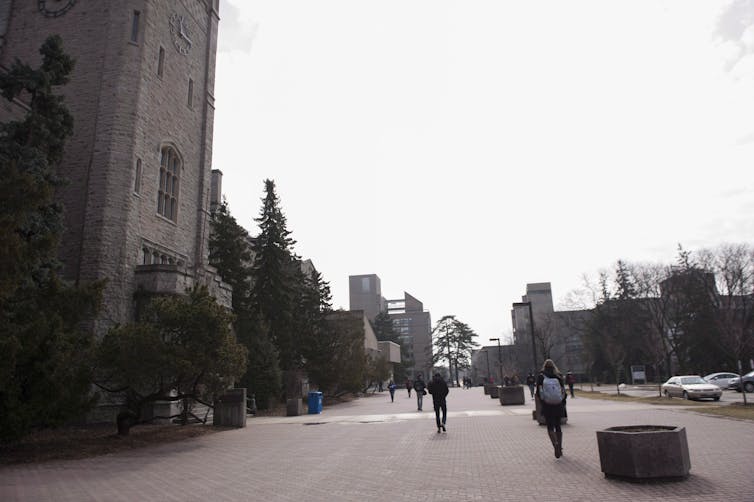 Many universities are attempting to develop appropriate policies for Indigenous identity verification that will address and possibly prevent false claims to Indigenous identity. The University of Guelph campus, where King is professor emeritus, in Guelph, Ont., in 2017.
THE CANADIAN PRESS/Hannah Yoon
Many universities are attempting to develop appropriate policies for Indigenous identity verification that will address and possibly prevent false claims to Indigenous identity. The University of Guelph campus, where King is professor emeritus, in Guelph, Ont., in 2017.
THE CANADIAN PRESS/Hannah Yoon
The University of Montréal is also in the process of developing a policy on Indigenous self-declaration, although it has not yet been formally adopted.
While there are many aspects to take into consideration, policies may vary from one institution or community to another. Yet across contexts, policy development about Indigenous identity will often lead to difficult conversations.
Indentity is personal and complex
As such policies emerge, it ought to be acknowledged that Indigenous identity is profoundly personal and complex. For instance, some Indigenous people may lack connections due to the Sixties Scoop phenomenon.
Read more: How journalists tell Buffy Sainte-Marie’s story matters — explained by a ’60s Scoop survivor
Viewing the complexities that may exist when considering an individual’s Indigenous identity as “challenges” might adversely affect our orientations toward the exercise.
Fundamentally, the constituent elements of one’s Indigenous identity ought to be treated charitably. This approach should not be understood as a dismissal of the problems experienced when one misrepresents their identity as being Indigenous. The concern here is the impact that such dialogue has upon Indigenous people and Peoples at large.
Rights of individuals, nations
We acknowledge the prevailing notion that claims of Indigenous identity ought to be consistent with the rights of nations: this has become an important concern for how Indigenous Peoples understand membership in their communities.
The current prevailing view among many is that some sort of national affiliation is central to any personal declaration to Indigenous identity.
Many academics have expressed confidence in the notion that Indigenous communities are in the best positions to determine how Indigenous identity may be understood in their respective communal or national contexts.
It is also important to include the rights of individuals in the conversation on Indigenous identity. This reflects what is contained in Article 33 of the United Nations Declaration on the Rights of Indigenous Peoples which affirms Indigenous peoples’ right to define their own identity and membership based on their customs and traditions.
Although connections to Indigenous communities are regarded as essential to claims of Indigenous identity, many Indigenous people may not be connected to their community.
Thus, claims to indigeneity made by those without such apparent connections must be considered carefully.
Non-material harms of false claims
While prospective policies around Indigenous identity are developed to regulate situations that would lead a person to make a false claim for material benefits — like access to funding or Indigenous-specific hiring — we believe that non-material impacts, such as community well-being and trust, should also be considered.
False declarations unquestionably impact the person and, sometimes, the reputation of the institution. These also also harm other groups like Indigenous academics, and wider research communities, through division and the erosion of confidence.
Impacts of misrepresentation
Although the Tribal Alliance Against Frauds highlighted the dubiousness of King’s claims to indigeneity, King has owned up publicly to his misrepresentation.
In an essay in The Globe and Mail, King shared what he had learned of his non-Cherokee ancestry, family stories shared about his darker skin, as well as the impacts that his misrepresentation has had on others.
Perhaps we can be charitable to a man who has learned about himself, set the record straight and contributed to a difficult conversation.
- Truth and reconciliation
- Indigenous identity
- university policy
- Thomas King
- 60s scoop
Events
Jobs
-
 Associate Lecturer/Lecturer, Interior Design
-
Lecturer / Senior Lecturer (Veterinary Biosciences)
-
Senior Lecturer, Autism & Neurodivergent Studies/Special Education
-
Manager, Graduations, Fees and Scholarships
-
Respect and Safety Project Manager
 Associate Lecturer/Lecturer, Interior Design
 Lecturer / Senior Lecturer (Veterinary Biosciences)
 Senior Lecturer, Autism & Neurodivergent Studies/Special Education
 Manager, Graduations, Fees and Scholarships
 Respect and Safety Project Manager
- Editorial Policies
- Community standards
- Republishing guidelines
- Analytics
- Our feeds
- Get newsletter
- Who we are
- Our charter
- Our team
- Partners and funders
- Resource for media
- Contact us
-
-
-
-
Copyright © 2010–2025, The Conversation