- Home
Edition
Africa Australia Brasil Canada Canada (français) España Europe France Global Indonesia New Zealand United Kingdom United States Edition:
Global
Edition:
Global
- Africa
- Australia
- Brasil
- Canada
- Canada (français)
- España
- Europe
- France
- Indonesia
- New Zealand
- United Kingdom
- United States
Academic rigour, journalistic flair
 Chris Wallace-Crabbe – Kristin Headlam (2011).
Author provided (no reuse)
Chris Wallace-Crabbe was a poet of international renown, a beloved teacher and a generous man
Published: December 19, 2025 12.55am GMT
David McCooey, Deakin University
Chris Wallace-Crabbe – Kristin Headlam (2011).
Author provided (no reuse)
Chris Wallace-Crabbe was a poet of international renown, a beloved teacher and a generous man
Published: December 19, 2025 12.55am GMT
David McCooey, Deakin University
Author
-
 David McCooey
Professor of Writing and Literature, Deakin University
Disclosure statement
David McCooey does not work for, consult, own shares in or receive funding from any company or organisation that would benefit from this article, and has disclosed no relevant affiliations beyond their academic appointment.
Partners

Deakin University provides funding as a member of The Conversation AU.
View all partners
DOI
https://doi.org/10.64628/AA.ggy4qnan9
https://theconversation.com/chris-wallace-crabbe-was-a-poet-of-international-renown-a-beloved-teacher-and-a-generous-man-272348 https://theconversation.com/chris-wallace-crabbe-was-a-poet-of-international-renown-a-beloved-teacher-and-a-generous-man-272348 Link copied Share articleShare article
Copy link Email Bluesky Facebook WhatsApp Messenger LinkedIn X (Twitter)Print article
Chris Wallace-Crabbe, who died at the age of 91 on Tuesday, was one of Australia’s best-known and best-loved poets. He was one of the few Australian poets of his generation, or any other, to have a significant international reputation.
His literary career stretches back over 60 years, to his debut collection, The Music of Division, published by Angus & Robertson in 1959. My copy of the book, only slightly foxed, is signed and dated by its author in May 1960, and then again, dedicated to me, in December 1997.
This sense of history – of the links across time and space – seems especially appropriate for a poet whose work was so wide-ranging in interest, so generous in its attention to people and things, and so sensitive to the continuities and discontinuities between times and places.
 Chris Wallace-Crabbe.
Kristin Headlam, via Wikimedia Commons, CC BY
Chris Wallace-Crabbe.
Kristin Headlam, via Wikimedia Commons, CC BY
Wallace-Crabbe was born in Richmond, Melbourne, in 1934, the son of a journalist and a pianist, and the elder brother of Robin Wallace-Crabbe, the renowned artist and writer.
He was an enthusiastic traveller and held a number of international academic appointments, including at Harvard University, but Melbourne was a constant in his life and work. He lived almost his entire life in the Victorian capital and had a long and distinguished academic career at the University of Melbourne. Indeed, along with colleagues, such as Vincent Buckley and R.A. Simpson, he was for a long time considered one of the “Melbourne poets”, a term that took in the university as much as the city.
He was one of the earliest teachers of creative writing as a university subject, and he was instrumental in the development of Australian studies as a discipline, being the founding director of the Australia Centre at the University of Melbourne, where he was emeritus professor at the time of his death.
It is appropriate that two of the numerous literary awards that Wallace-Crabbe received in his career were The Age Book of the Year Award (in 1995) and the Melbourne Prize for Literature (in 2015).
Wallace-Crabbe’s early work is notable, in part, for its attention to Australian suburbia, a subject largely ignored or denigrated at the time. To some extent, Wallace-Crabbe belonged to a transitional poetic generation, one that linked the traditionalism of older poets, such as James McAuley and Rosemary Dobson, with the experimentalism of the so-called “Generation of ’68” poets, such as John Forbes and Laurie Duggan.
This interplay between oppositions is characteristic of Wallace-Crabbe’s work, which playfully brings together the local and the international, the historical and the contemporary, the vernacular and the bookish. This last can be seen in Trace Elements, from Rungs of Time (1993), in which the poet meditates on the age-old theme of the dead:
Space-time is no longer their medium; they inhabit antipodes of the radiant fair dinkum, post-Heisenberg, transphysical, post-Planck, taunting us with quips of antimatter.
As this suggests, Wallace-Crabbe had a catholic, transdisciplinary love of knowledge. He was fond of citing in conversation the philosopher Isaiah Berlin’s idea that writers and thinkers were either “hedgehogs” (who know “one big thing” and prefer unity and coherence) or “foxes” (who know “many things” and are comfortable with plurality and ambiguity). He proudly identified as a fox.
Part of this foxiness was the way his interest in the theoretical and abstract was always balanced by a loving attention to the “twiggy particular”, as he called it in Stuff Your Classical Heritage from I’m Deadly Serious (1988).
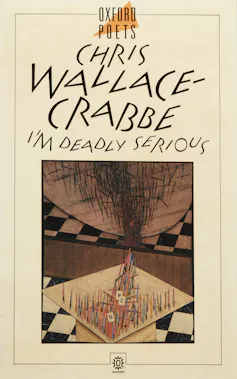
Ultimately, Wallace-Crabbe’s concern with oppositions means that he was most profoundly a tragicomic poet, with the elegiac and the comedic characteristically found within the same poem. As he said in an interview in 1990 with Barbara Williams, “the comic mode, in the fullest, most complicated, sense takes in enormous contradictions and essentially asserts that, given these contradictions, something goes on. I think of that as a basis for my writing: tragedy, taken far enough, ends up as comedy.”
Wallace-Crabbe’s concern with the elegiac themes of mortality, loss and transience was most profoundly challenged by the tragic death of his adult son, Ben, in 1986. In the first of a number of poems about this terrible event, An Elegy, Wallace-Crabbe movingly wishes to
…pluck my son, out of dawn’s moist air […] like a pink-tinged angel and gather him gasping back into this life.
While some early critics had found Wallace-Crabbe worked at something of a remove from the emotional intensities of real life, relying especially on irony, these elegies show that his poetry could be emotionally intense, even as it engaged in the stylistic affordances of lyric poetry.
 Chris Wallace-Crabbe – Kristin Headlam (2011).
Author provided (no reuse)
Chris Wallace-Crabbe – Kristin Headlam (2011).
Author provided (no reuse)
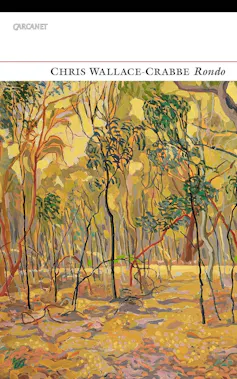
From the mid 1980s, Wallace-Crabbe was published in the prestigious Oxford Poets series, then published by Oxford University Press. His later collections showed no diminution of his poetic powers, and his last book, Rondo (2018), continued his tragicomic project of tracking humanity’s hilarious and mournful condition across history’s “harsh millennia”, as he terms them in the opening poem of Rondo, Creature.
Wallace-Crabbe was a gregarious, generous man. He was beloved as a teacher. He had a liking for busyness and physical activity, playing tennis well into old age. All of this is consistent not only with his poetry, but the numerous anthologies, critical works, and essays that he produced throughout his life.
Generations of students and colleagues benefited from his wisdom and generosity. To mark his 80th birthday in 2014 Travelling Without Gods: A Chris Wallace-Crabbe Companion was published, edited by Cassandra Atherton.
Wallace-Crabbe’s aesthetic interests included music and, especially, visual art. He produced a number of artist’s books with the Melbourne artist, Bruno Leti, among others.
The prize-winning artist Kristin Headlam has been Wallace-Crabbe’s partner for over 25 years. The two of them lived rich creative lives together, as seen in Headlam’s portraits of Wallace-Crabbe, the artworks that grace the covers of his later poetry collections, and her 64 etchings responding to his eccentric modern epic poem, The Universe Looks Down (2005).
 About the House – Kristin Headlam (2007).
Author provided (no reuse)
About the House – Kristin Headlam (2007).
Author provided (no reuse)
As my opening paragraphs suggest, I write about Chris Wallace-Crabbe not entirely with scholarly disinterest. Chris was a one-off, with an infectious and endearing enthusiasm for life. To me he was a mentor and a great friend, and I feel privileged to have known him. As well as Headlam, he is survived by his children Georgia, Toby and Joshua, and his five grandchildren.
As much as he loved ideas, Wallace-Crabbe, appropriately for a poet, primarily loved language itself. He had an extraordinary skill in working with his medium. He was especially adept at the catalogue (or poetic list), playfully illustrating the rich, sometimes absurd, plurality of life. As he put it in The Thing Itself, from I’m Deadly Serious,
I would like to go right back, devising a sentence unlike any such creature in creation; like nothing on this planet: a structure full of brackets and cornices, twigs, pediments, dadoes and haloes and nimbs, full of nuts, butter and flowers! sinewy, nerved, capable of blotches or of waving hair. That would be a sentence to really show the buggers…
It would indeed.
- Poetry
- Australian literature
- Obituary
- Australian poetry
Events
Jobs
-
 Associate Lecturer/Lecturer, Interior Design
-
Lecturer / Senior Lecturer (Veterinary Biosciences)
-
Senior Lecturer, Autism & Neurodivergent Studies/Special Education
-
Manager, Graduations, Fees and Scholarships
-
Respect and Safety Project Manager
 Associate Lecturer/Lecturer, Interior Design
 Lecturer / Senior Lecturer (Veterinary Biosciences)
 Senior Lecturer, Autism & Neurodivergent Studies/Special Education
 Manager, Graduations, Fees and Scholarships
 Respect and Safety Project Manager
- Editorial Policies
- Community standards
- Republishing guidelines
- Analytics
- Our feeds
- Get newsletter
- Who we are
- Our charter
- Our team
- Partners and funders
- Resource for media
- Contact us
-
-
-
-
Copyright © 2010–2025, The Conversation