
- Home
Edition
Africa Australia Brasil Canada Canada (français) España Europe France Global Indonesia New Zealand United Kingdom United States Edition:
Global
Edition:
Global
- Africa
- Australia
- Brasil
- Canada
- Canada (français)
- España
- Europe
- France
- Indonesia
- New Zealand
- United Kingdom
- United States
Academic rigour, journalistic flair
 The first sighting of Terefe, the endangered Ethiopian wolf, after his release from rehabilitation.
Courtesy Fasika N., Ethiopian Wolf Conservation Programme
Africa’s rarest carnivore: the story of the first Ethiopian wolf ever captured, nursed and returned to the wild
Published: December 24, 2025 6.55am GMT
Sandra Lai, University of Oxford
The first sighting of Terefe, the endangered Ethiopian wolf, after his release from rehabilitation.
Courtesy Fasika N., Ethiopian Wolf Conservation Programme
Africa’s rarest carnivore: the story of the first Ethiopian wolf ever captured, nursed and returned to the wild
Published: December 24, 2025 6.55am GMT
Sandra Lai, University of Oxford
Author
-
 Sandra Lai
Postdoctoral Researcher, Ethiopian Wolf Conservation Programme, University of Oxford
Disclosure statement
Sandra Lai does not work for, consult, own shares in or receive funding from any company or organisation that would benefit from this article, and has disclosed no relevant affiliations beyond their academic appointment.
Partners

University of Oxford provides funding as a member of The Conversation UK.
View all partners
DOI
https://doi.org/10.64628/AAJ.vdcf67ukf
https://theconversation.com/africas-rarest-carnivore-the-story-of-the-first-ethiopian-wolf-ever-captured-nursed-and-returned-to-the-wild-269927 https://theconversation.com/africas-rarest-carnivore-the-story-of-the-first-ethiopian-wolf-ever-captured-nursed-and-returned-to-the-wild-269927 Link copied Share articleShare article
Copy link Email Bluesky Facebook WhatsApp Messenger LinkedIn X (Twitter)Print article
What’s the value of one animal? When a wild animal is found badly injured, the most humane option is often euthanasia to prevent further suffering. That’s what usually happens, and often for good reason. Even when the resources to rescue one animal are available, a rehabilitated animal brought back into the wild might be rejected by its group, or struggle to find food or escape predators. If it does survive, it may fail to reproduce, and leave no lasting mark on the population.
But every so often a single case comes along where one animal becomes evidence that intervention can do more than save a life on the spot. It can also change what we think is possible.
Read more: Battling to save the Ethiopian wolf – Africa's rarest carnivore
This is a story of a second chance that played out in the Simien Mountains, Ethiopia. The air is thin there at 3,000 metres above sea level, the nights are cold, and life offers very little mercy. This is the home of the Ethiopian wolf (Canis simensis), the top predator in this habitat and also the most endangered carnivore in Africa. Fewer than 500 adult wolves are left in the Ethiopian highlands, with about 60-70 in the Simien Mountains.
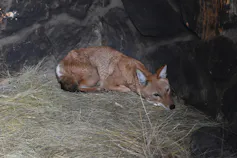 Terefe, just before his release.
Fasika N, Wildlife Conservation Network
Terefe, just before his release.
Fasika N, Wildlife Conservation Network
In early May 2020, a male Ethiopian wolf sustained a severe injury, a fractured femur, from a gunshot. He was unable to keep up with his pack in a place as unforgiving as the highlands, and that would usually be the end of the story. But this time, it wasn’t.
I’m a postdoctoral researcher in the Ethiopian Wolf Conservation Programme, a 30-year-old programme committed to safeguarding the Ethiopian wolf and its mountain home. I was honoured to be part of a team who documented the first ever case of an Ethiopian wolf being rescued, clinically treated in captivity, and successfully released back into the wild following rehabilitation.
Terefe, the lucky survivor
 Simien Mountains wolf monitoring team, Andualem, Getachew and Jejaw (from left)
Courtesy Sandra Lai
Simien Mountains wolf monitoring team, Andualem, Getachew and Jejaw (from left)
Courtesy Sandra Lai
Park scouts discovered the wolf lying under a bridge and alerted Getachew Assefa, the wolf monitor team leader of the Ethiopian Wolf Conservation Programme in the Simien Mountains National Park.
It’s unusual for an Ethiopian wolf to be shot in the park. So, Ethiopian wildlife authorities and the Ethiopian Wolf Conservation Programme decided to capture and save the frightened animal.
Read more: Simply returning rescued wildlife back to the wild may not be in their best interest
This was an unprecedented step, as there was no previous record of an Ethiopian wolf ever being held in captivity before. The decision to save him was driven both by the fact that his injury was human-made and by the small number of Simien wolves left.
A small mountain shelter was quickly converted into a makeshift enclosure for the wolf. There, over the next 51 days, his rehabilitation began.
Read more: Conservation hope: Many wildlife species can recover if given a chance
In the following weeks, the wolf received intensive veterinary treatment guided by Ethiopian wolf experts. He was cared for by local community guard Chilot Wagaye. At first, progress was uncertain, but then the broken bones began to heal and, after a month, the wolf could stand on its own.
He was named Terefe, meaning “lucky survivor” in Amharic, the local language.
Returning to the wild: a story of hope
After his leg recovered, Terefe’s eagerness to leave the shelter started to show. He was howling at night, perhaps as an attempt to call his pack members.
In late June 2020, he was released back near his pack, fitted with a lightweight GPS collar, the first ever deployed on an Ethiopian wolf. This allowed researchers to follow his movements and explore a critical question: could a rehabilitated wolf reintegrate into the wild?
The Ethiopian Wolf Conservation Programme tracked Tefere’s movements after he healed from his injury to make sure he was doing ok.Soon after his release, sightings showed that Terefe had been welcomed back into his pack. He stayed within his original territory for several weeks. But soon, he began to travel more widely in the mountains, sometimes visiting neighbouring packs, and eventually settling near Shehano village.
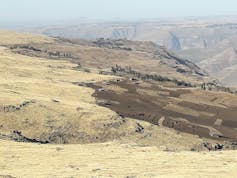 The tiny village of Shehano.
Courtesy Ethiopian Wolf Conservation Programme
The tiny village of Shehano.
Courtesy Ethiopian Wolf Conservation Programme
At first, villagers were surprised to see a wolf near their homes and tried to chase him away. But wolf monitors, led by Getachew and Chilot, explained Terefe’s story of survival.
Learning more about this wolf prompted a change of attitude. It increased the villagers’ willingness to protect Terefe … and his new pack members! Indeed, Terefe had found a mate and they had a litter of pups.
A historic rescue that protected more than one life
Today, the “Terefe pack” still exists. Terefe not only survived, but created a new legacy. He also changed something that’s really important but difficult to measure: local perceptions. Wolves are sometimes seen as a threat. But because of Terefe, they became a symbol of resilience and a source of pride.

Terefe’s story does not mean that every injured wild animal can or should be saved. But when intervention is carefully executed, one life can carry more meaning than expected, not only for an endangered species, but also for the people living alongside it. Today, Getachew often tells me that no one would ever harm Terefe.
Read more: Africa's mammals may not be able to keep up with the pace of climate change
Will Terefe’s fame protect his pack members after he is gone? Will it protect other members of his species? Terefe was saved from an injury made by human hands, yet many other wolves fade slowly and quietly, killed by rabies and canine distemper transmitted by domestic dogs, an indirect consequence of human presence in the mountains.
Yet, Terefe’s story is a reminder that conservation efforts are the strongest when local organisations work together with local communities. His story shows how much can be achieved when many people who care about the same landscape come together.
- Ethiopian wolf
- Natural world
Events
Jobs
-
 Research Assistant, Quantum-enabled super-resolution imaging
-
Product Manager, Recognition of Capabilities (ROC)
-
Lecturer / Senior Lecturer (Veterinary Biosciences)
-
Senior Lecturer, Autism & Neurodivergent Studies/Special Education
-
Respect and Safety Project Manager
 Research Assistant, Quantum-enabled super-resolution imaging
 Product Manager, Recognition of Capabilities (ROC)
 Lecturer / Senior Lecturer (Veterinary Biosciences)
 Senior Lecturer, Autism & Neurodivergent Studies/Special Education
 Respect and Safety Project Manager
- Editorial Policies
- Community standards
- Republishing guidelines
- Analytics
- Our feeds
- Get newsletter
- Who we are
- Our charter
- Our team
- Partners and funders
- Resource for media
- Contact us
-
-
-
-
Copyright © 2010–2025, The Conversation