
- Home
Edition
Africa Australia Brasil Canada Canada (français) España Europe France Global Indonesia New Zealand United Kingdom United States Edition:
Global
Edition:
Global
- Africa
- Australia
- Brasil
- Canada
- Canada (français)
- España
- Europe
- France
- Indonesia
- New Zealand
- United Kingdom
- United States
Academic rigour, journalistic flair
The evolution of digital nomadism: from hi-tech hacker spaces to crypto coworking
Published: December 24, 2025 2.40pm GMT
Dave Cook, UCL, Olga Hannonen, University of Eastern Finland
Authors
-
 Dave Cook
PhD Candidate in Anthropology, UCL
-
Olga Hannonen
Researcher, PhD, University of Eastern Finland
Disclosure statement
The authors do not work for, consult, own shares in or receive funding from any company or organisation that would benefit from this article, and have disclosed no relevant affiliations beyond their academic appointment.
Partners

University College London provides funding as a founding partner of The Conversation UK.
View all partners
DOI
https://doi.org/10.64628/AB.tk756udkv
 Working on a laptop while looking out over terraced rice fields in Chiang Mai, northern Thailand.
Torjrtrx/Shutterstock
https://theconversation.com/the-evolution-of-digital-nomadism-from-hi-tech-hacker-spaces-to-crypto-coworking-272380
https://theconversation.com/the-evolution-of-digital-nomadism-from-hi-tech-hacker-spaces-to-crypto-coworking-272380
Link copied
Share article
Working on a laptop while looking out over terraced rice fields in Chiang Mai, northern Thailand.
Torjrtrx/Shutterstock
https://theconversation.com/the-evolution-of-digital-nomadism-from-hi-tech-hacker-spaces-to-crypto-coworking-272380
https://theconversation.com/the-evolution-of-digital-nomadism-from-hi-tech-hacker-spaces-to-crypto-coworking-272380
Link copied
Share article
Share article
Copy link Email Bluesky Facebook WhatsApp Messenger LinkedIn X (Twitter)Print article
One of the first modern coworking spaces, C-Base in Berlin, was launched 30 years ago by a group of computer engineers as a “hacker space” in which to share their tech and techniques. Similarly, many of the people we first encountered in our anthropological research into the emerging world of digital nomadism in the mid-2010s were hackers and computer coders.
Nearly a decade later, we returned to Chiang Mai to see what had happened to these pioneers of the borderless, desk-free life. We wondered if they had been put off by the throngs of travellers who have followed in their sandal-clad footsteps, attracted by glamorous – if often inaccurate – images of the digital nomad lifestyle.
One of the city’s nomad hotspots is Yellow Coworking, which launched in 2020 as a blockchain-oriented, collaborative escape zone from the COVID pandemic. The later stages of the pandemic were an interesting time to be in Chiang Mai: Russia’s full-scale invasion of Ukraine in February 2022 was followed by mass layoffs in Silicon Valley when Twitter, Meta, Coinbase and Microsoft all made significant cuts.
Yellow Coworking saw an influx of former Silicon Valley workers, Russian and Ukrainian coders, and crypto enthusiasts. “Some ex-Silicon Valley employees are here playing around with startups,” one Yellow staff member explained. “It makes sense for them to come here if they are trying to create an MVP” (that’s “minimum viable product” – startup jargon for a basic prototype that, with luck, will become the next technological success story).
“With its lower costs,” the staff member added, “Chiang Mai gives them a longer runway” (the amount of time the startup can remain solvent without raising additional funds).
People walking into Yellow Coworking’s modernist, European-style building simply raise their hands to sign themselves in via biometric fingerprint scanners. Many are computer coders or IT specialists in their 20s, taking advantage of fast broadband and (mostly western) passports to disconnect their lives from any particular location. They view technology and code as a global language, with no need to stay rooted to a single country or location.
Vitalik Buterin, creator of ethereum – the decentralised blockchain behind the world’s second biggest cryptocurrency, Ether – was often a focus of discussion at Yellow’s regular meet-ups. Buterin has identified as a digital nomad for most of the past decade, claiming to live out of a 40-litre backpack. Like many crypto folk, he views this borderless lifestyle as making perfect ideological sense.
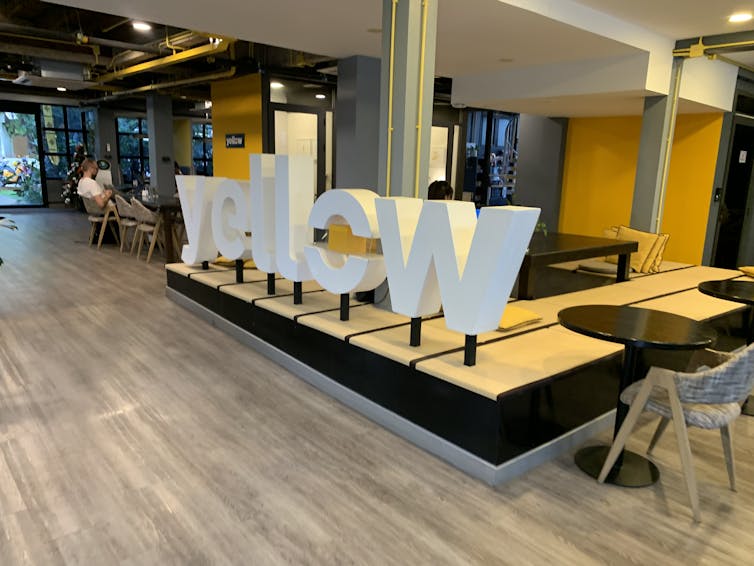 Yellow Coworking in Chiang Mai hosts a mix of ex-Silicon Valley workers, Russian and Ukrainian coders, and crypto enthusiasts.
Dave Cook, CC BY-NC-SA
Yellow Coworking in Chiang Mai hosts a mix of ex-Silicon Valley workers, Russian and Ukrainian coders, and crypto enthusiasts.
Dave Cook, CC BY-NC-SA
The borderless revolution
In Chiang Mai, cryptocurrency usage has spread to the local population. During one meet-up held in a local bar, the owner took payment for shots of Thai rum in bitcoin. She too talked about the borderless revolution that was coming, and crypto being part of her financial future.
One of the western “crypto nomads” present was trying to launch his own cryptocoin (built on Buterin’s ethereum ecosystem) and get others to invest in it. A few tables away, another who had invested – and lost – a fortune in cryptocurrency explained he was now living in Chiang Mai because of the city’s relatively low cost of living.
For every success story, there were tales of loss and potential scams. Some told outlandish stories of crypto startups and other projects that were hard to validate. One person who wrote eBooks on how to invest successfully in crypto was selling courses on how to get involved. Another was writing code to improve the security of the ethereum blockchain system, to ensure it would be safe from hackers.
A valuable asset for states
Digital nomad hotspots, which also include European cities such as Lisbon in Portugal, show how the worlds of cryptocurrency, blockchain and digital nomadism are colliding – and evolving beyond mere workspace provision.
A collaborative, incubator-like atmosphere is at the core of The Block Lisboa, where you can pay in cryptocurrency and which hosts weekly Crypto Fridays for networking, collaboration and ideas sharing. In 2023, it held the first Ethereum Block Summit, which promised to “delve into the future of finance” by exploring “groundbreaking advancements in the ethereum ecosystem”.
Meanwhile, CV Labs is building a blockchain ecosystem of its own, comprising coworking spaces, events and summits in Lisbon and four other cities including Vaduz in Liechtenstein and Zug – part of Switzerland’s “Crypto Valley”. These spaces are open to cryptocurrency professionals and enthusiasts with professional exchange in mind.
Digital nomads are becoming a valuable asset for states to compete for – as Tsugio Makimoto and David Manners predicted they would in their 1997 book, Digital Nomad. “Just as we are already seeing governments competing with each other to attract industrial investment,” they wrote, “we may see governments competing with each other for citizens.”
Malaysia’s digital nomad visa initially targeted only nomads from IT and digital professions such as cybersecurity and software development. Estonia launched a digital nomad visa along with its e-residency programme to target high-skilled digital workers. While these visas typically restrict local employment, many allow nomads to bring family members and offer a path to residency, such as in Spain and Portugal.
Coworking spaces started off as techno-utopian, hacker spaces. Thirty years later, they are an increasingly important aspect of some cities’ tourism calculations – having been given further allure by the rise of the niche group of crypto nomads.
- Thailand
- Bitcoin
- Portugal
- Technology
- Cryptocurrency
- Ethereum
- Digital nomads
- Crypto
- Cryptocurrency platforms
- Give me perspective
Events
Jobs
-
 Research Assistant, Quantum-enabled super-resolution imaging
-
Product Manager, Recognition of Capabilities (ROC)
-
Lecturer / Senior Lecturer (Veterinary Biosciences)
-
Senior Lecturer, Autism & Neurodivergent Studies/Special Education
-
Respect and Safety Project Manager
 Research Assistant, Quantum-enabled super-resolution imaging
 Product Manager, Recognition of Capabilities (ROC)
 Lecturer / Senior Lecturer (Veterinary Biosciences)
 Senior Lecturer, Autism & Neurodivergent Studies/Special Education
 Respect and Safety Project Manager
- Editorial Policies
- Community standards
- Republishing guidelines
- Analytics
- Our feeds
- Get newsletter
- Who we are
- Our charter
- Our team
- Partners and funders
- Resource for media
- Contact us
-
-
-
-
Copyright © 2010–2025, The Conversation