- Home
Edition
Africa Australia Brasil Canada Canada (français) España Europe France Global Indonesia New Zealand United Kingdom United States Edition:
Global
Edition:
Global
- Africa
- Australia
- Brasil
- Canada
- Canada (français)
- España
- Europe
- France
- Indonesia
- New Zealand
- United Kingdom
- United States
Academic rigour, journalistic flair
 The Adoration of the Magi, painted by Giotto di Bondonne, featuring a bright comet as the Christmas star.
Giotto di Bondonne
What was the ‘Christmas Star’? Astronomy might hold the answer
Published: December 24, 2025 8.42pm GMT
Jonti Horner, University of Southern Queensland, Duane Hamacher, The University of Melbourne
The Adoration of the Magi, painted by Giotto di Bondonne, featuring a bright comet as the Christmas star.
Giotto di Bondonne
What was the ‘Christmas Star’? Astronomy might hold the answer
Published: December 24, 2025 8.42pm GMT
Jonti Horner, University of Southern Queensland, Duane Hamacher, The University of Melbourne
Authors
-
 Jonti Horner
Professor (Astrophysics), University of Southern Queensland
-
Duane Hamacher
Associate Professor, School of Physics, The University of Melbourne
Disclosure statement
Duane Hamacher received funding from the Australian Research Council and the University of Melbourne. He is also President of the International Society for Archaeoastronomy and Astronomy in Culture, and the Australian Association for Astronomy in Culture.
Jonti Horner does not work for, consult, own shares in or receive funding from any company or organisation that would benefit from this article, and has disclosed no relevant affiliations beyond their academic appointment.
Partners

University of Melbourne provides funding as a founding partner of The Conversation AU.
University of Southern Queensland provides funding as a member of The Conversation AU.
View all partners
DOI
https://doi.org/10.64628/AA.fw4nts7u9
https://theconversation.com/what-was-the-christmas-star-astronomy-might-hold-the-answer-270358 https://theconversation.com/what-was-the-christmas-star-astronomy-might-hold-the-answer-270358 Link copied Share articleShare article
Copy link Email Bluesky Facebook WhatsApp Messenger LinkedIn X (Twitter)Print article
In the run up to Christmas, carols fill the air. Many have an astronomical twist, singing of the “Christmas Star” from the story of the nativity. Described in the Gospel of Matthew, the star guided the three wise men to the cradle of the young baby Jesus in a manger in Bethlehem.
Most Biblical scholars agree Jesus was born between 6 and 4 BCE. It’s not known what time of year he was born, but those scholars suggest it was most likely in April or May.
The choice of December 25 to celebrate Jesus’ birth came centuries later, and is tied to the date of the winter solstice in the Roman calendar, when the northern hemisphere experiences its shortest day.
Many Biblical scholars also view the Christmas Star, which is also known as the Star of Bethlehem, as pious fiction – a symbolic story meant to establish the messianic status of Jesus, rather than a real event. But what if it was some sort of astronomical phenomenon?
Astronomers have long pondered this question and proffered some potential explanations. Perhaps historical records from across the globe might reveal what the Magi saw, and help to work out exactly when the events in the story happened.
If so, what could the Christmas Star have been?
A bright comet?
The idea that the Christmas Star might have been a bright comet has a long history. The Adoration of the Magi, painted in 1305 by Giotto di Bondonne, featured a comet in pride of place as the Christmas Star.
Giotto’s cometary Christmas Star was inspired by the bright apparition of comet 1P/Halley, which the artist observed in 1301. So could 1P/Halley, or another bright comet, have been the Star of Bethlehem?
Comet Halley orbits the Sun every 74 to 79 years, so it has made regular spectacular appearances throughout human history. It was widely observed across the planet in the year 12 BCE – too early to be the star of the Christmas Story.
What about other comets? Well, astronomers and historians have dug through the records of comets seen by cultures across the globe, and only one comet stands out as a potential candidate for the story.
A comet is recorded in ancient Chinese records, seen in 5 BCE. That comet was flagged as a potential Star of Bethlehem in the late 1990s, with the Chinese observations noting the comet was visible for more than 70 days.
Recently, the idea that the comet of 5 BCE could have been the Christmas Star has leapt back into focus, thanks to research that suggests the comet of 5 BCE followed an unusual path through the inner Solar System, and made a remarkably close approach to Earth. In that scenario, the comet would have appeared almost stationary in the sky for a lengthy period of time – all the hallmarks of the star from the Nativity.
Read more: Stories from the sky: astronomy in Indigenous knowledge
A supernova?
Some astronomers have argued a supernova would be an ideal candidate for the Christmas Star. Supernovae are immense explosions caused either by massive stars reaching the end of their lives, or white dwarfs (the remains of a star like the Sun) suffering a terminal case of stellar indigestion as they devour a companion.
Both types of supernova are a spectacular sight – outshining the combined light of all other stars in their host galaxies for a period of several weeks. As a result, supernovae that explode within our own galaxy, the Milky Way, can become highly prominent – sometimes even becoming bright enough to be visible in daylight.
 A supernova captured by the Hubble Space Telescope in January 2018.
ESA/Hubble & NASA, A. Riess and the SH0ES team. Acknowledgment: Mahdi Zamani, CC BY-NC-ND
A supernova captured by the Hubble Space Telescope in January 2018.
ESA/Hubble & NASA, A. Riess and the SH0ES team. Acknowledgment: Mahdi Zamani, CC BY-NC-ND
Once again, astronomers pored over ancient records, looking to find potential observations of a bright supernova that would fit with the nativity story.
Reports from Korea to Palestine described a new star in the night sky – an object that was most likely a supernova. It is estimated to have peaked in brightness around February 23 in 4 BCE, in the constellation of Aquila, the Eagle.
This could be a good fit. In February, Aquila rises in the east in the early morning, a few hours before sunrise. As such, a bright supernova in that part of the sky would be a spectacular morning star high in the eastern sky – remaining bright for several weeks before fading away, never to be seen again.
A planetary conjunction?
In recent years, the most common claim for the Christmas Star is that it was actually a planetary conjunction. This is when planets get very close to one another in the sky, as happened back in December 2020 with the “Great Conjunction” of Jupiter and Saturn.
This idea has been raised, on and off, for more than four centuries, since the great scientist Johannes Kepler suggested in 1614 that the triple conjunction of Jupiter and Saturn in 7 BCE could have triggered a nova that became the star in question.
The 7 BCE conjunction was far from spectacular, with Jupiter and Saturn separated by more than a degree. But just a few years later, in 2 BCE, there were a striking series of conjunctions between the brightest planets in the sky: Jupiter and Venus.
Could one of those conjunctions have been the Christmas Star? It seems unlikely. The Venus–Jupiter conjunctions would have been seen in the evening sky, low in the west – making them a poor fit to the nativity story.
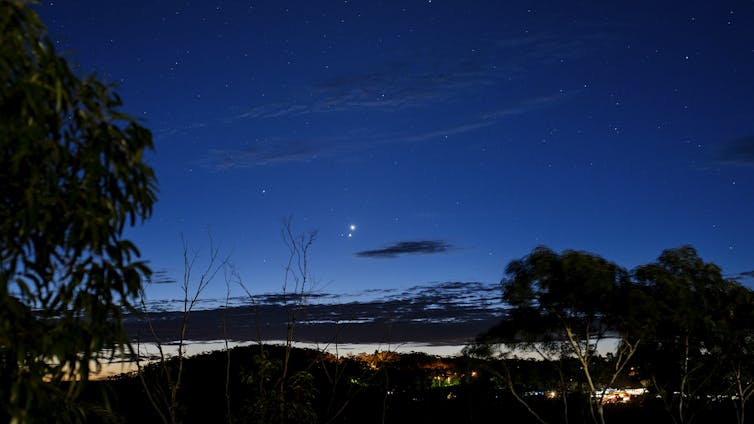 A conjunction of Jupiter and Venus in the evening sky of August 28 2016.
Peter Lieverdink, CC BY-NC-ND
A conjunction of Jupiter and Venus in the evening sky of August 28 2016.
Peter Lieverdink, CC BY-NC-ND
Or perhaps, there was no star?
None of the explanations put forward to date seem to perfectly match the story passed down through the centuries.
So it might just be the case that there simply was no Christmas Star - that the story truly is a pious fiction.
But it is still worth considering what it might have been; at the very least, it can teach us about some of the many wonders of the universe. And who knows what more we will discover in the years to come – we certainly haven’t heard the last speculation about the true nature of the “Star of Wonder”.
- Astronomy
- Planets
- Christmas
- Christianity
- Supernovae
- Comets
- Jesus
Events
Jobs
-
 Research Assistant, Quantum-enabled super-resolution imaging
-
Product Manager, Recognition of Capabilities (ROC)
-
Lecturer / Senior Lecturer (Veterinary Biosciences)
-
Senior Lecturer, Autism & Neurodivergent Studies/Special Education
-
Respect and Safety Project Manager
 Research Assistant, Quantum-enabled super-resolution imaging
 Product Manager, Recognition of Capabilities (ROC)
 Lecturer / Senior Lecturer (Veterinary Biosciences)
 Senior Lecturer, Autism & Neurodivergent Studies/Special Education
 Respect and Safety Project Manager
- Editorial Policies
- Community standards
- Republishing guidelines
- Analytics
- Our feeds
- Get newsletter
- Who we are
- Our charter
- Our team
- Partners and funders
- Resource for media
- Contact us
-
-
-
-
Copyright © 2010–2025, The Conversation