- Home
Edition
Africa Australia Brasil Canada Canada (français) España Europe France Global Indonesia New Zealand United Kingdom United States Edition:
Global
Edition:
Global
- Africa
- Australia
- Brasil
- Canada
- Canada (français)
- España
- Europe
- France
- Indonesia
- New Zealand
- United Kingdom
- United States
Academic rigour, journalistic flair
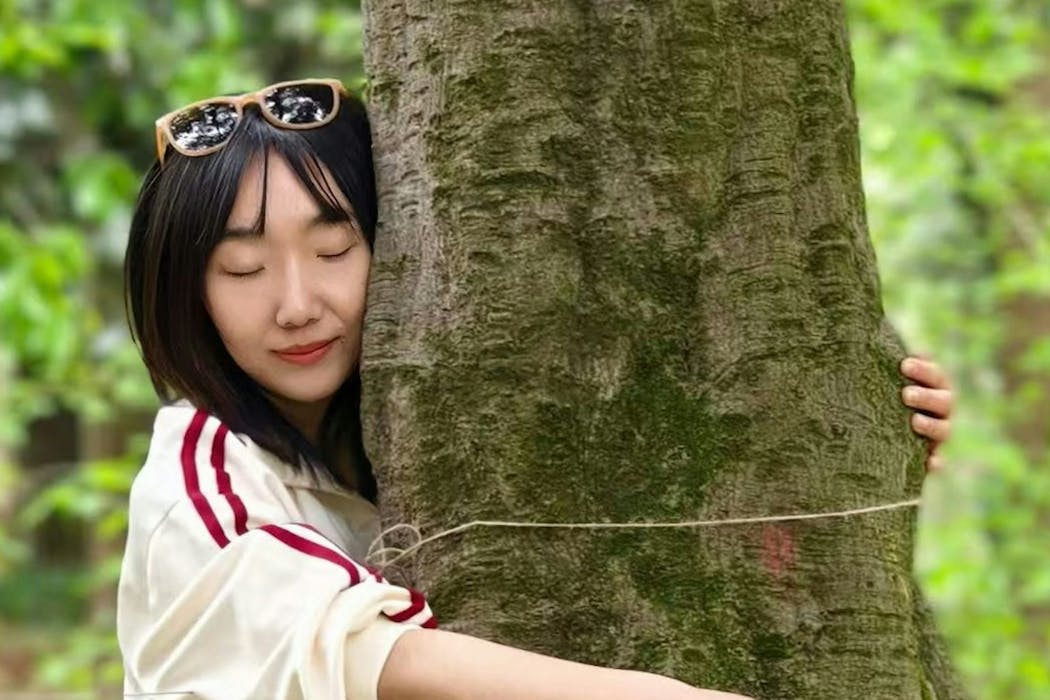
 Forest therapist Xinjun Yang enjoys tree hugging in Beijing.
Xiaoyand, CC BY-NC-ND
Why so many young people in China are hugging trees
Published: December 23, 2025 1.09pm GMT
Akanksha Awal, SOAS, University of London
Forest therapist Xinjun Yang enjoys tree hugging in Beijing.
Xiaoyand, CC BY-NC-ND
Why so many young people in China are hugging trees
Published: December 23, 2025 1.09pm GMT
Akanksha Awal, SOAS, University of London
Author
-
 Akanksha Awal
Lecturer, Social Anthropology, SOAS, University of London
Disclosure statement
Akanksha Awal receives funding from the ESRC, Leverhulme Trust, and St John's College. I would like to thank Hangzhang Ding, an undergraduate at Peking University at the time, who accompanied me in the forest therapy session and provided translations throughout the day.
Partners

SOAS, University of London provides funding as a member of The Conversation UK.
View all partners
DOI
https://doi.org/10.64628/AB.hd5suxp96
https://theconversation.com/why-so-many-young-people-in-china-are-hugging-trees-269832 https://theconversation.com/why-so-many-young-people-in-china-are-hugging-trees-269832 Link copied Share articleShare article
Copy link Email Bluesky Facebook WhatsApp Messenger LinkedIn X (Twitter)Print article
In Beijing’s central district, trees are everywhere. In parks, along roadsides and in courtyards inside people’s houses. Many have only been planted in recent decades.
Others – with wide trunks – have been around for centuries and are cosy to touch: you can form an arm chain around them with a friend, trace your fingers along the bark or rest your ear on the trunk to listen to the inner workings of the tree. To hug a tree is an art. This ability does not come intuitively. It must be learned.
“Hugging trees is a way of having touch in one’s life,” Xiaoyang Wong, the leader of a forest therapy community in Beijing, told me. Wong is a 35-year-old former film editor who recently retrained as a forest therapist after the COVID pandemic left her feeling alone and isolated.
At first, many people feel awkward about hugging a tree, she told me. But in forest therapies, Wong encourages people to understand the tree’s many worlds by observing it at close quarters, watching the ants and other insects as they weave in and out of the grain of the bark.
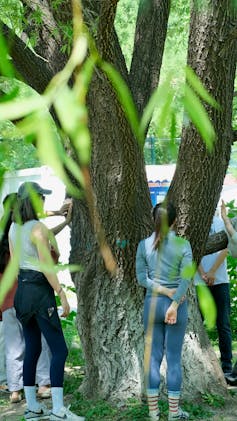 People in forest therapy touching the tree.
Yuan Yutong
People in forest therapy touching the tree.
Yuan Yutong
Only after being curious about it and speaking with it, she encourages people to decide to touch or even hug it. I was a natural at tree hugging, she told me. I, however, had only learned how to hug a tree from watching other people do this supposedly silly practice in parks across the city.
In Beijing, most of the ancient trees are fenced in by the local government to protect them from damage; however, the newer ones are still available for people to touch and gather around.
Seeking relief
On weekends and even late at night, I discovered people – young and old, mothers and daughters, friends and lovers – hugging trees or resting their backs against a trunk while seeking relief from everyday stresses.
These stresses have compounded, especially after the COVID pandemic when loneliness and isolation became commonplace. Moreover, as many young women in China contest the idea of marriage, they seek friendships and new ways of pursuing a good life.
Trees, scholars argue, make young people feel “rooted” and “alive”. In my interviews with more than 25 young women and men as part of my ongoing research – which is yet to be published – I discovered that more women than men went to forest therapy, seeking both friendship with trees and other human beings.
In these therapies, Wong adapted the traditional forest bathing therapies with her own ideas to enhance people’s engagement. These include “plant enactment” where people could take on the name of their favourite tree, and be called by this name all day. She encouraged us, the participants in the therapy, to share a gesture that we associated with our chosen plant, one that described how we imagined the tree would move.
Wong was joined in these sessions by other women who too had given up the pursuit of high-pressure jobs, and had instead taken this part-time work to look after people, trees and plants in the city.
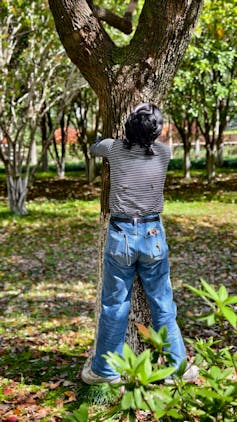 A young woman learning to hug a tree in a forest therapy session.
Kong Xiaoyang
A young woman learning to hug a tree in a forest therapy session.
Kong Xiaoyang
In one of these group sessions, a tree hugger, Florian Mo, expressed his frustration at not being able to find and sustain love in his life. He argued that a key problem with Chinese society was the stigmatisation of the pursuit of love at a young age.
He was 28 and reeling from a break-up. But for Mo, this was only because he had never learned how to love when he was a teenager. If he had done so, not only would he be a better partner today, as he shared with us, he would also be able to move on from his current heartbreak more easily.
For young people like Wong and Mo, trees emerged as spaces to explore themselves and connections to each other. And while the story of China’s urbanisation is often told through images of polluted air, water and soil, young people like Wong and Mo present an alternative narrative: that young Chinese generations seek to repair the urban environment by connecting with others while caring, nurturing and even hugging the trees with their friends and strangers.

Don’t have time to read about climate change as much as you’d like? Get a weekly roundup in your inbox instead. Every Wednesday, The Conversation’s environment editor writes Imagine, a short email that goes a little deeper into just one climate issue. Join the 47,000+ readers who’ve subscribed so far.
- China
- Nature
- Trees
- Motivate me
Events
Jobs
-
 Research Assistant, Quantum-enabled super-resolution imaging
-
Product Manager, Recognition of Capabilities (ROC)
-
Lecturer / Senior Lecturer (Veterinary Biosciences)
-
Senior Lecturer, Autism & Neurodivergent Studies/Special Education
-
Respect and Safety Project Manager
 Research Assistant, Quantum-enabled super-resolution imaging
 Product Manager, Recognition of Capabilities (ROC)
 Lecturer / Senior Lecturer (Veterinary Biosciences)
 Senior Lecturer, Autism & Neurodivergent Studies/Special Education
 Respect and Safety Project Manager
- Editorial Policies
- Community standards
- Republishing guidelines
- Analytics
- Our feeds
- Get newsletter
- Who we are
- Our charter
- Our team
- Partners and funders
- Resource for media
- Contact us
-
-
-
-
Copyright © 2010–2025, The Conversation