
- Home
Edition
Africa Australia Brasil Canada Canada (français) España Europe France Global Indonesia New Zealand United Kingdom United States Edition:
Global
Edition:
Global
- Africa
- Australia
- Brasil
- Canada
- Canada (français)
- España
- Europe
- France
- Indonesia
- New Zealand
- United Kingdom
- United States
Academic rigour, journalistic flair
 Martin Parr at his We Love Britain! exhibition in 2015.
AP / Alamy
Martin Parr: an astute and uniquely British photographer
Published: December 23, 2025 3.55pm GMT
Mark Durden, University of South Wales
Martin Parr at his We Love Britain! exhibition in 2015.
AP / Alamy
Martin Parr: an astute and uniquely British photographer
Published: December 23, 2025 3.55pm GMT
Mark Durden, University of South Wales
Author
-
 Mark Durden
Emeritus Professor, University of South Wales
Disclosure statement
Mark Durden does not work for, consult, own shares in or receive funding from any company or organisation that would benefit from this article, and has disclosed no relevant affiliations beyond their academic appointment.
Partners

University of South Wales provides funding as a member of The Conversation UK.
View all partners
DOI
https://doi.org/10.64628/AB.7ctuxkyum
https://theconversation.com/martin-parr-an-astute-and-uniquely-british-photographer-272316 https://theconversation.com/martin-parr-an-astute-and-uniquely-british-photographer-272316 Link copied Share articleShare article
Copy link Email Bluesky Facebook WhatsApp Messenger LinkedIn X (Twitter)Print article
The kitsch, the gaudy, the banal, the common, the superficial, the cheap: Martin Parr – who has died at the age of 73 – embraced and celebrated them all in his extraordinary pictures.
Born in Epsom in 1952 to solidly middle-class Methodist parents, Parr’s suburban childhood was dominated by his parents’ church going and passionate interest in ornithology. He was a keen trainspotter. His interest in photography was kindled by his grandfather George Parr, an amateur photographer, with whom Parr spent his childhood holidays in Yorkshire.
“I make serious photographs disguised as entertainment,” he once said, but the very nature of his photography saw some in his profession deny him the respect and acknowledgement he deserved.
His work chimed with elements of pop art and its obsession with consumerism, but in the photography world – certainly within the UK – there still seemed to be a certain cultural snobbery and unease about consciously engaging with this subject matter.
 Promenade Press / Dewi Lewis Publishing
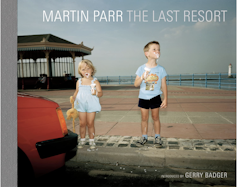
Part of that unease is to do with how the kitsch and the common are, certainly in Britain, bound up in questions of taste and class. Parr’s exhibition and book The Last Resort (1983-1986) brought him important recognition, including a show at London’s Serpentine Gallery, but also much criticism for its harsh portrayal of working-class people holidaymaking in New Brighton, Merseyside.
A life in pictures
Inspired by what was then the new American colour photography and the work of photographers such as Stephen Shore and William Eggleston, as well the British colour photographer John Hinde, Parr’s pictures broke with the more sober and gloomy black and white British documentary photography tradition.
Exploring the life and work of Martin Parr.Deploying similar colour saturation to the summer holiday postcard, Parr countered its idealism by focusing on scenes of slovenliness, notably through pictures showing the consumption of food – chips, hot dogs, ice creams – with all the ensuing spillage.
Both the beach and lido were crowded and littered, and people seemed oblivious to the mess around them. As a result, some saw such pictures as presenting a degraded vision of the working-class people of this popular northern seaside resort. But despite its critics, Last Resort has remained in print since it was published and is his bestselling book.
The Cost of Living (1986-1989) offered a counterpoint to The Last Resort, concentrating on a more appearance-driven and aspirational culture: the uptight realm of the comfortable middle classes, exemplified through vivid, cutting and critical portraits of people at social gatherings, shopping or keeping fit.
 Dewi Lewis Publishing
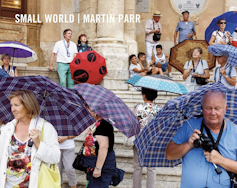
For Small World (1987-1994), his photography took on the bigger subject of worldwide travel. His critical and comical response to tourism often rested upon a witty interplay between the people and the attractions they had come to consume, many of them shown carrying cameras or videos or taking photographs.
Here the comedy is bathetic, as we sense the shortfall between the sublime nature of what the masses have come to see and the plethora of tourist tat that filters that encounter.
The tourists’ clothing also became a recurring focus and point of irony – such as the back of a yellow t-shirt with the single word “Bali”, worn by a tourist as they contemplate Gaudí’s Sagrada Familia in Barcelona, or a man in a loud summer shirt bearing an image of a tropical sunset in the Piazza della Signoria, Florence.
Parr’s remarkable and most significant book, Common Sense (1999) conveyed an apocalyptic vision of humanity’s over-consumption, a global binge presented through a glut of images, all in close up. It is a crazed delirious montage, as if replaying fragments drawn from all his past work, but with the colour saturation racked up.
Common Sense also marked a shift in the form of the photo book in its use of full-bleed images (where the images extend to the edges of the page) throughout, from front cover to back, and the only text, the title, author and publisher imprint. Parr had been a passionate collector of photo books since the beginning of his career and saw the photo book as the ideal way of both presenting and disseminating photographs.
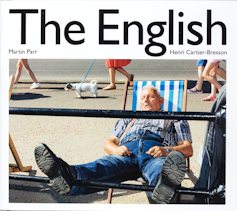 A Parr photobook project undertaken with the great Henri Cartier-Bresson.
Dewi Lewis Publishing
A Parr photobook project undertaken with the great Henri Cartier-Bresson.
Dewi Lewis Publishing
Publishing multi-volumes on the photo book with various authors, his work in this field is an important part of his legacy. His collection of over 12,000 photo books was part gifted to and purchased by the Tate galleries in 2017.
In 2014, he established the Martin Parr Foundation which opened as a dedicated photography space in 2017 in Bristol. As well as providing an archive of his photography, the foundation shows and collects the work of photographers who make work focused on Britain and Ireland. It also seeks to support and promote younger, emerging photographers.
When travelling the world, Parr started having his picture taken by local street and studio photographers, as well as in photo booths. The resulting portraits constitute his most comic book, Autoportrait, (2000; expanded and revised in 2016) with Parr deadpanning amid a carnival of possible and other selves created for him.
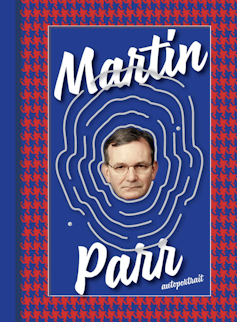 Parr’s Autoportrait.
Dewi Lewis Publishing
Parr’s Autoportrait.
Dewi Lewis Publishing
Rooted in the passion and joy of the tradition of photographic portraiture, Autoportrait is also an important document of less-feted photographic practices, such as the humble photo booth, as well as a testimony to the creativity and imaginings of others.
It also bears comparison with the collaborative photobook Julie Bullard (2025) for which Parr “documented” scenarios reflecting the creative imaginings of another, this time the artist and filmmaker, Nadia Lee Cohen.
Cohen hired Parr to take pictures of tableaux she created, as she and family members played out a fictional version of the life and death of the glamorous babysitter she idolised as a child in in the 1990s.
Cohen’s stylised and over the top fantasy about a working-class life, was already imbued with Parr’s now distinctive aesthetic. To be asked to photograph her project meant he was in effect also photographing himself. As one of his last significant projects, it seems a beautifully absurd and comic ending to an extraordinary and exceptional artistic life and career.
This article features references to books that have been included for editorial reasons, and may contain links to bookshop.org; if you click on one of the links and go on to buy something, The Conversation UK may earn a commission.

Looking for something good? Cut through the noise with a carefully curated selection of the latest releases, live events and exhibitions, straight to your inbox every fortnight, on Fridays. Sign up here.
- Photography
- Realism
- Documentary Photography
- Give me perspective
- British class system
Events
Jobs
-
 Research Assistant, Quantum-enabled super-resolution imaging
-
Product Manager, Recognition of Capabilities (ROC)
-
Lecturer / Senior Lecturer (Veterinary Biosciences)
-
Senior Lecturer, Autism & Neurodivergent Studies/Special Education
-
Respect and Safety Project Manager
 Research Assistant, Quantum-enabled super-resolution imaging
 Product Manager, Recognition of Capabilities (ROC)
 Lecturer / Senior Lecturer (Veterinary Biosciences)
 Senior Lecturer, Autism & Neurodivergent Studies/Special Education
 Respect and Safety Project Manager
- Editorial Policies
- Community standards
- Republishing guidelines
- Analytics
- Our feeds
- Get newsletter
- Who we are
- Our charter
- Our team
- Partners and funders
- Resource for media
- Contact us
-
-
-
-
Copyright © 2010–2025, The Conversation