
- Home
Edition
Africa Australia Brasil Canada Canada (français) España Europe France Global Indonesia New Zealand United Kingdom United States Edition:
Global
Edition:
Global
- Africa
- Australia
- Brasil
- Canada
- Canada (français)
- España
- Europe
- France
- Indonesia
- New Zealand
- United Kingdom
- United States
Academic rigour, journalistic flair
 Writer and lawyer Saeed Teebi in discussion with author Fatme Abdallah at Western University, Nov. 10, 2025.
(Fatme Abdallah) , Author provided (no reuse)
Author Saeed Teebi writes beyond exile in his memoir of Palestine and writing in dark times
Published: December 22, 2025 8.41pm GMT
Fatme Abdallah, Western University
Writer and lawyer Saeed Teebi in discussion with author Fatme Abdallah at Western University, Nov. 10, 2025.
(Fatme Abdallah) , Author provided (no reuse)
Author Saeed Teebi writes beyond exile in his memoir of Palestine and writing in dark times
Published: December 22, 2025 8.41pm GMT
Fatme Abdallah, Western University
Author
-
 Fatme Abdallah
PhD Candidate, English and Writing Studies, Western University
Disclosure statement
Fatme Abdallah receives funding from Social Sciences and Humanities Research Council (SSHRC).
Partners

Western University provides funding as a member of The Conversation CA-FR.
Western University provides funding as a member of The Conversation CA.
View all partners
DOI
https://doi.org/10.64628/AAM.wxetd4m5u
https://theconversation.com/author-saeed-teebi-writes-beyond-exile-in-his-memoir-of-palestine-and-writing-in-dark-times-270130 https://theconversation.com/author-saeed-teebi-writes-beyond-exile-in-his-memoir-of-palestine-and-writing-in-dark-times-270130 Link copied Share articleShare article
Copy link Email Bluesky Facebook WhatsApp Messenger LinkedIn X (Twitter)Print article
Writer and lawyer Saeed Teebi released an Instagram video on Sept. 30, 2025, announcing the publication of his new book, You Will Not Kill Our Imagination: A Memoir of Palestine and Writing in Dark Times.
In the video, Teebi acknowledged that while his book publication day should have been a happy one, he grappled with celebrating a moment of success while accounting for and living with “everything that is going on in Palestine.”
As a researcher of Palestinian prison literature who has been tracking the intermittent hostage exchanges between Israel and Gaza during the recent ceasefire agreement, Teebi’s struggle to articulate his feelings seemed familiar.
It echoed the experiences of Palestinians released from prison who could not celebrate their newfound freedom while their homeland was still under siege.
As Teebi narrates in his book, both sets of grandparents were survivors of the 1948 Nakba when when more than 750,000 Palestinians were driven from their homes during the mass exodus that accompanied the founding of the state of Israel.
As Teebi writes, they moved on a “tour of degradation through various Arab states” before they “stumbled” to Kuwait in the 1950s, where Teebi was born and lived as a child. At age 12, the family was stranded in California during a family trip when Iraq, under Saddam Hussein, invaded Kuwait. Teebi and his family lived for a time in the United States before coming to Canada when he was a youth.
The book is Teebi’s personal and political efforts to come to terms with the failures and powers of language to narrate a Palestinian story that can stand for itself, free of the constraints that attempt to silence it.
A story ‘against narrative’
Just days before the book’s publication, a United Nations Independent International Commission of Inquiry on the Occupied Palestinian Territory officially labelled Israel’s actions a genocide after a staggering death toll in Gaza.
Teebi’s witnessing of what he calls “an unending corpse exhibition” against the world’s latent, often ineffectual responses brought him to the realization that until that point, his identity and history had been confined by the “little prisons everywhere” made from language.
For someone who describes himself as having “an abiding faith in language,” the “dark times” Teebi refers to in the title of his book were ones of reckoning: the language to name Palestinian experience broadly and mass death in Gaza had irrevocably failed to stop genocide.
Read more: Flawed notions of objectivity are hampering Canadian newsrooms when it comes to Gaza
Teebi notes how amid the reluctance of western media and governments to use the term “genocide,” even as some genocide scholars saw evidence of this phenomenon as early as late 2023, Palestinians were forced to “haggle” over vocabulary rather than mobilizing diplomatic pressure to prevent “massacres” from happening.
In so doing, the book draws a clear analogy between Israeli practices of apartheid and related censorship of language which Teebi terms “linguistic apartheid.” This echoes Palestinian literature’s concern with resisting discourse that dispossesses Palestinians of their land-based identities.
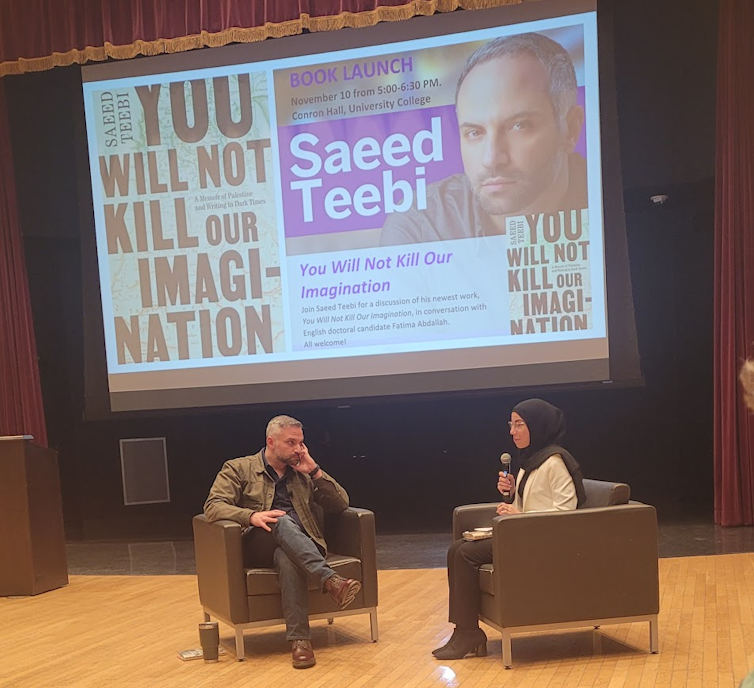 You Will Not Kill Our Imagination’ is Teebi’s second book, following a short story collection ‘Her First Palestinian’ published in 2022. The author in dialogue with Fatme Abdallah at Western University on Nov. 10, 2025.
(Fatme Abdallah), Author provided (no reuse)
You Will Not Kill Our Imagination’ is Teebi’s second book, following a short story collection ‘Her First Palestinian’ published in 2022. The author in dialogue with Fatme Abdallah at Western University on Nov. 10, 2025.
(Fatme Abdallah), Author provided (no reuse)
‘Prisons of what we can and can’t say’
Teebi, like journalist Ta-Nehisi Coates, is concerned with how conventional narratives can be used to justify ethnic cleansing.
In Coates’ book The Message, which partly reports on his summer 2023 visit to the West Bank and East Jerusalem, he writes that western language about Palestine has elevated “factual complexity” over morality or justice. The end goal was “to forge a story of Palestine told solely by the colonizer.”
Teebi writes that there have been long-existing “prisons of what we can and can’t say” about Palestine that repressed any attempt to engage in historical or political debate. Some of these “prisons,” he notes, were enforced by an “abundance of caution” on the part of his late migrant father, a doctor who expressed an “obsessive drive to rebuild” after the family was displaced from Kuwait.
Such “prisons” were a response to, and buttressed by, the dominance of an Israeli-centric narrative of Israel’s founding in the West, which has made it so that every Palestinian story appears as a counternarrative that “carries the whiff of subversiveness.”
A Palestinian story must inevitably carve space against the presiding mythology of a land without people for a people without a land.
Between real and linguistic prisons
As I read the book in preparation for an interview with Teebi at a launch at Western University on Nov. 10 — where he was the 2024-25 writer-in-residence — I was struck by how deeply prison imagery shaped his memoir.
Prisons targeting Palestinians operate materially in Occupied Palestine, but often only discursively, or linguistically, in the West.
Teebi acknowledges that the former “are [much] worse prisons”, yet his book is nonetheless a response to the linguistic prisons that obscure Palestinian stories behind claims of neutrality, proportionality or legality:
“When every popular conception of you is that of someone in chains, you begin to feel the chains even if they aren’t physically there. You narrate yourself not in spite of the chains, but around them.”
Between witnessing and imagining
When Palestinian American writer Sarah Aziza wrote the article “The Work of the Witness,” now included in the anthology The Best American Essays of 2025, it had only been three months into the genocide in Gaza.
I had then been convinced of the power and necessity of witnessing.
Yet as lands and bodies in Gaza were devastated, I increasingly believed witnessing offered no solution.
I was both gratified and dismayed that Teebi seemed to agree when, in You Will Not Kill Our Imagination, he wrote that witnessing is “the hoariest of writerly clichés.”
While Teebi’s book attempts to define “the effects of the genocide on Palestinian art and imagination,” it is also a reflection of how people in exile might resist the prisons imposed by a society dominated by anti-Palestinian narratives.
For Teebi, this entails embracing the “engine” of imagination — telling a Palestinian story that refuses the confines of counter-narrative.
A Palestinian story that must be told
Most important of all, Teebi tells a personal and political narrative, unqualified and unapologetic, a testament to the defiance of a Palestinian story that insists on being told.
In a number of talks, Teebi states that he had never intended to write a memoir: being so personal imposed upon him both honesty and vulnerability. Yet the moment compelled him to challenge the societal constraints that had kept his identity in check and to affirm, openly, deliberately and imaginatively, his Palestinian identity: he had broken free from the metaphoric prisons reining in his imagination.
When I suggested this to him in our interview, he laughed, saying: “If you want to call me a prison breaker, I’ll take it.”
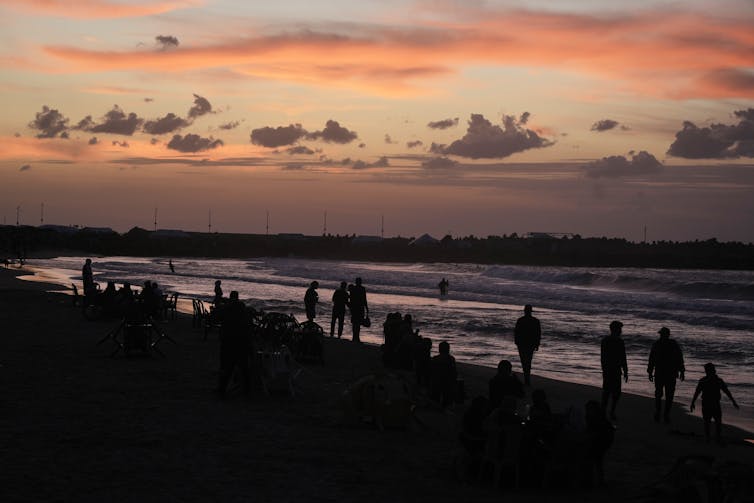 Palestinians walk along the beachfront at Gaza City’s port on Dec. 9, 2025.
(AP Photo/Jehad Alshrafi)
Palestinians walk along the beachfront at Gaza City’s port on Dec. 9, 2025.
(AP Photo/Jehad Alshrafi)
Task of writer-in-exile
The writer-in-exile, Teebi insists, must do more than bear witness, a task carried out more forcefully by those living through this genocide. The exile who writes owes something to the stories of their loved ones who have lived, fought for and honoured an increasingly precarious future.
And so the exile who writes must witness ethically by committing, without hesitation, to this future; the exile who writes must imagine dismantling the prisons that bind their language; the exile who writes must imagine fiercely, granting themselves unrestrained freedom to speak, act and live.
I will end with these words by Mahmoud Darwish:
“Prison deprives one of the sight of a tree and the sea. Freedom is the imagination capable of recalling them both in prison, making the invisible visible. No, that is what poetry does. Poetry, then, is an act of freedom.”
To merely witness prison, argues Teebi, is not to resist it; one must instead imagine beyond its constraints in the exercise of freedom.
That, for Teebi, is the quintessential work of the writer: to imagine a future beyond the societal and linguistic prisons that exile enforces.
- Genocide
- Gaza war
Events
Jobs
-
 Research Fellow (Level A) - Reproductive Health
-
Product Manager, Recognition of Capabilities (ROC)
-
Lecturer / Senior Lecturer (Veterinary Biosciences)
-
Senior Lecturer, Autism & Neurodivergent Studies/Special Education
-
Respect and Safety Project Manager
 Research Fellow (Level A) - Reproductive Health
 Product Manager, Recognition of Capabilities (ROC)
 Lecturer / Senior Lecturer (Veterinary Biosciences)
 Senior Lecturer, Autism & Neurodivergent Studies/Special Education
 Respect and Safety Project Manager
- Editorial Policies
- Community standards
- Republishing guidelines
- Analytics
- Our feeds
- Get newsletter
- Who we are
- Our charter
- Our team
- Partners and funders
- Resource for media
- Contact us
-
-
-
-
Copyright © 2010–2025, The Conversation