- Home
Edition
Africa Australia Brasil Canada Canada (français) España Europe France Global Indonesia New Zealand United Kingdom United States Edition:
Global
Edition:
Global
- Africa
- Australia
- Brasil
- Canada
- Canada (français)
- España
- Europe
- France
- Indonesia
- New Zealand
- United Kingdom
- United States
Academic rigour, journalistic flair
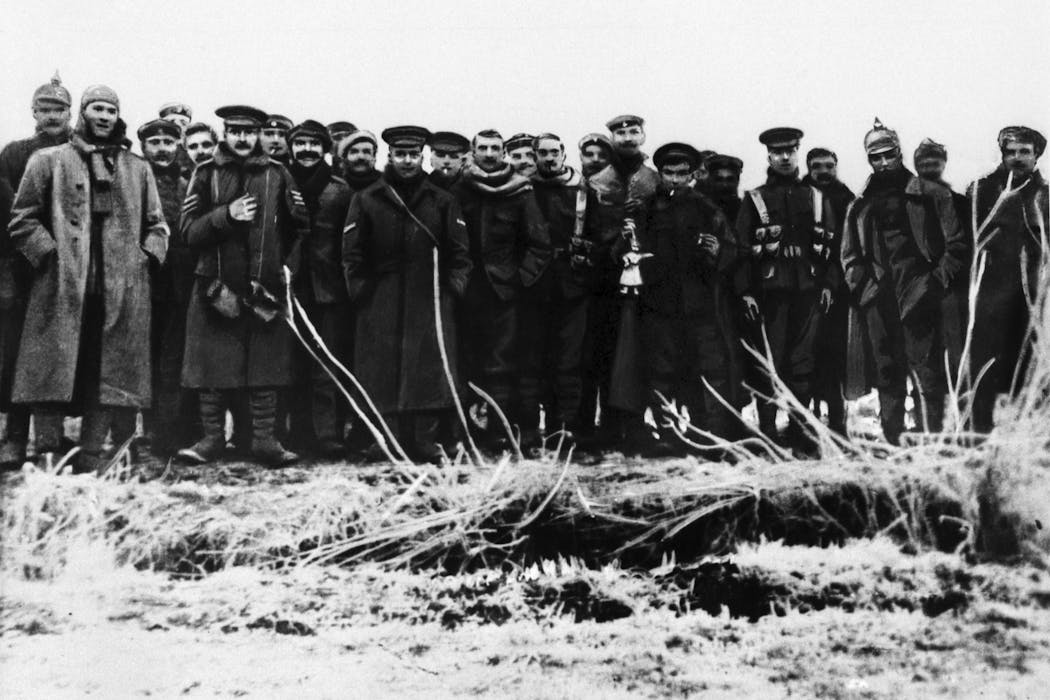
 British and German troops observe a temporary truce on Christmas Day 1914.
Daily Mirror/Mirrorpix via Getty Images
From truce in the trenches to cocktails at the consulate: How Christmas diplomacy seeks to exploit seasonal goodwill
Published: December 20, 2025 12.40pm GMT
Andrew Latham, Macalester College
British and German troops observe a temporary truce on Christmas Day 1914.
Daily Mirror/Mirrorpix via Getty Images
From truce in the trenches to cocktails at the consulate: How Christmas diplomacy seeks to exploit seasonal goodwill
Published: December 20, 2025 12.40pm GMT
Andrew Latham, Macalester College
Author
-
 Andrew Latham
Professor of Political Science, Macalester College
Disclosure statement
Andrew Latham does not work for, consult, own shares in or receive funding from any company or organisation that would benefit from this article, and has disclosed no relevant affiliations beyond their academic appointment.
Partners

Macalester College provides funding as a member of The Conversation US.
View all partners
DOI
https://doi.org/10.64628/AAI.sk3wugttu
https://theconversation.com/from-truce-in-the-trenches-to-cocktails-at-the-consulate-how-christmas-diplomacy-seeks-to-exploit-seasonal-goodwill-271478 https://theconversation.com/from-truce-in-the-trenches-to-cocktails-at-the-consulate-how-christmas-diplomacy-seeks-to-exploit-seasonal-goodwill-271478 Link copied Share articleShare article
Copy link Email Bluesky Facebook WhatsApp Messenger LinkedIn X (Twitter)Print article
President Donald Trump is reportedly setting his sights on a Christmas peace deal in the Ukraine-Russia war.
The timing is apt. Every December, political leaders reach instinctively for the language of goodwill. Meanwhile, diplomats the world over use the season to host parties at which gift-giving and booze are used to help foster friendships.
The notion that the holiday season might bring a respite from conflict has deep roots in history. Medieval “Christmas peace” laws in northern Europe at one point punished crimes committed during the season with harsher penalties, enshrining in law a cultural sense of expectation for quiet and restraint.
Finland still reads the Declaration of Christmas Peace each Christmas Eve – a ceremonial reminder of an older hope that violence might briefly ebb.
Today’s “Christmas diplomacy” – that is, a range of statements and efforts to encourage peace and warm relations between nations — updates the tradition for statecraft.
Sometimes, such diplomacy really does open a window for talks. Sometimes it is a cultural reflex. Sometimes it is pure theater. And sometimes, the season’s distractions are exploited for war and violence rather than peace.
The most famous of them all
The Treaty of Ghent that ended the War of 1812 between the United States and Great Britain was signed on Christmas Eve. It was a signal that both sides were ready to convert seasonal sentiment into durable peace.
But the most famous example of the season interrupting conflict is the Christmas Truce of 1914. After months of fighting along parts of the Western Front in World War I, soldiers on opposing sides left the trenches to sing, retrieve the dead and share a moment of humanity before returning to the industrial warfare from which many of them would never return.
This act was repeated during the Battle of the Bulge in World War II, when a small number of American and German soldiers struck a temporary truce in the Hürtgen Forest during Christmas 1944.
 Guests enjoy martinis and shots of vodka during a party at the Russian Embassy in Washington in 2007.
Getty Images for Russian Standard
Guests enjoy martinis and shots of vodka during a party at the Russian Embassy in Washington in 2007.
Getty Images for Russian Standard
A seasonal opening to dialogue?
More recently, governments and nongovernmental actors have leveraged the holidays to open the door for future peace negotiations.
In Northern Ireland, for example, the Provisional IRA repeatedly declared Christmas ceasefires, most notably in December 1974 when it announced a halt to operations from Dec. 22 through early January. While the truce ultimately collapsed, it reflected a recurring pattern during The Troubles in which Christmas provided a culturally resonant moment to signal openness to dialogue.
A similar logic was observed more recently in Colombia, where in 2022, the National Liberation Army (ELN) declared a unilateral Christmas ceasefire, explicitly tying the pause in hostilities to ongoing peace negotiations with the government.
In both cases, Christmas functioned not as a sentimental interruption to war, but as a strategic moment to legitimize restraint and probe whether diplomacy could bring an end to the underlying conflict.
But as with any temporary ceasefire, Christmas truces can be prone to violations. During the Vietnam War, warring parties in 1971 agreed to a 24-hour Christmas truce. A report from The New York Times the following day included allegations of 19 violations by the Vietcong and 170 by American and South Vietnamese forces.
The holidays can also serve as an opportunity to catch an enemy off guard.
Seven years before the short-lived 1971 Christmas truce, Vietcong fighters chose Christmas Eve to launch an attack on a hotel where U.S. officers were celebrating. Two Americans were killed and 28 were injured.
The Soviet Union launched its 1979 invasion of Afghanistan on Christmas Eve, and Israel’s 2008 Gaza operation began on Dec. 27. The logic here is that in late December, political bandwidth in national capitals is thin, diplomatic machinery moves more slowly and the opportunity for surprise is greater.
‘Tis the season for …
Christmas diplomacy can therefore be used to encourage peace – or war.
It can also be used to deepen existing bilateral friendships.
A well-known example is Norway’s annual donation of Christmas trees to the United Kingdom. The practice began in 1947, when Oslo sent a giant spruce to London’s Trafalgar Square as a thank-you for British support during World War II. It has since become a ritualized expression of common history, shared sacrifice and enduring alliance.
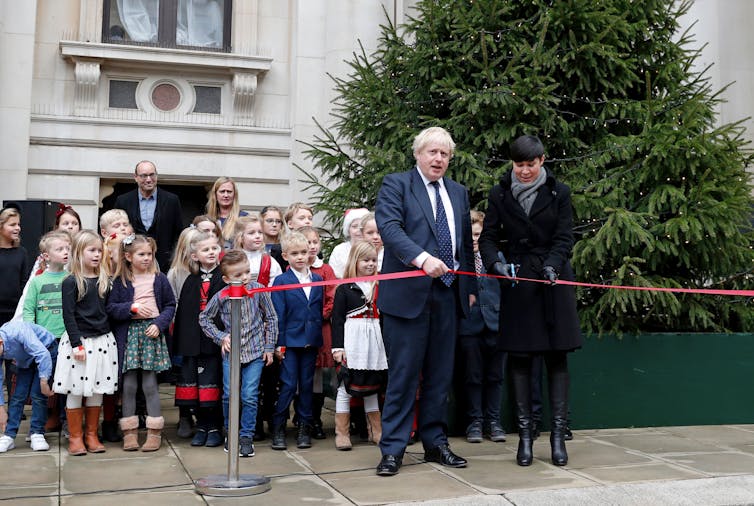 Then foreign secretaries Ine Eriksen Soreide of Norway and Boris Johnson of the U.K. unveil the 2017 Christmas tree gifted by Norway.
Adrian Dennis/AFP via Getty Images
Then foreign secretaries Ine Eriksen Soreide of Norway and Boris Johnson of the U.K. unveil the 2017 Christmas tree gifted by Norway.
Adrian Dennis/AFP via Getty Images
And embassies around the world host Christmas receptions that function as informal diplomatic spaces – occasions where tensions ease, conversations flow more freely and difficult issues can be broached in a more relaxed setting.
These practices do not resolve crises but lay important groundwork for goodwill and access.
Christmas diplomacy endures because it stands at the crossroads of culture, power and politics. The season brings with it a set of expectations about restraint and goodwill that leaders can invoke, diplomats can exploit and adversaries can either honor or abuse.
This article is part of a series explaining foreign policy terms commonly used but rarely explained.
- Diplomacy
- War
- Northern Ireland
- World War II
- World War I
- Christmas
- Colombia
- Ukraine
- Vietnam War
- Trump administration
- Ukraine invasion 2022
- Ceasefire
- Foreign Policy 101
Events
Jobs
-
 Product Manager, Recognition of Capabilities (ROC)
-
Associate Lecturer/Lecturer, Interior Design
-
Lecturer / Senior Lecturer (Veterinary Biosciences)
-
Senior Lecturer, Autism & Neurodivergent Studies/Special Education
-
Respect and Safety Project Manager
 Product Manager, Recognition of Capabilities (ROC)
 Associate Lecturer/Lecturer, Interior Design
 Lecturer / Senior Lecturer (Veterinary Biosciences)
 Senior Lecturer, Autism & Neurodivergent Studies/Special Education
 Respect and Safety Project Manager
- Editorial Policies
- Community standards
- Republishing guidelines
- Analytics
- Our feeds
- Get newsletter
- Who we are
- Our charter
- Our team
- Partners and funders
- Resource for media
- Contact us
-
-
-
-
Copyright © 2010–2025, The Conversation