
- Technology
- Computing
Physicists have transformed a decades-old technique for simplifying quantum equations into a reusable, user-friendly "conversion table" that works on a laptop and returns results within hours.
0 Comments Join the conversationWhen you purchase through links on our site, we may earn an affiliate commission. Here’s how it works.
 (Image credit: Curly_photo/Getty Images)
Physicists have developed a way to model quantum systems on everyday computers, making it easier to run complex simulations without relying on supercomputers or artificial intelligence (AI) tools.
The new method updates "truncated Wigner approximation" (TWA), a decades-old technique for approximating quantum behavior, into a plug-and-play shortcut for solving complex calculations.
You may like-
 'This moves the timeline forward significantly': Quantum computing breakthrough could slash pesky errors by up to 100 times
-
 Quantum computing 'lie detector' finally proves these machines tap into Einstein's spooky action at a distance rather than just faking it
-
 Quantum internet inches closer thanks to new chip — it helps beam quantum signals over real-world fiber optic cables
"Our approach offers a significantly lower computational cost and a much simpler formulation of the dynamical equations," study co-author Jamir Marino, an assistant professor of physics at the State University of New York at Buffalo, said in a statement. "We think this method could, in the near future, become the primary tool for exploring these kinds of quantum dynamics on consumer-grade computers."
A modern spin on a semiclassic
First developed in the 1970s, TWA is a "semiclassical" simulation method used to predict quantum behavior.
Quantum systems are governed by the rules of quantum mechanics and typically involve particles at impossibly small scales. At this level, phenomena like coherence and entanglement produce effects that can't be fully explained by classical physics alone.
Because these effects generate an enormous number of possible outcomes, simulating them often requires massive computing power — for example, supercomputer clusters or AI networks. To make quantum dynamics easier to study on conventional hardware, physicists often use a theoretical framework called semiclassical physics.
Sign up for the Live Science daily newsletter nowContact me with news and offers from other Future brandsReceive email from us on behalf of our trusted partners or sponsorsBy submitting your information you agree to the Terms & Conditions and Privacy Policy and are aged 16 or over.Semiclassical physics involves treating parts of a quantum equation through the lens of quantum mechanics and other parts with classical physics, allowing researchers to approximate how a quantum system might behave over time.
TWA works by transforming a quantum problem into multiple, simplified classical calculations, each starting with a small amount of statistical "noise" to account for the inherent uncertainty of quantum mechanics. By running these simplified calculations and averaging the results, researchers get a sufficient picture of how the quantum problem would play out.
However, TWA was initially developed for "idealized" quantum systems that are completely isolated from outside forces. This makes the math far more manageable because it assumes the system evolves without interference.
You may like-
'This moves the timeline forward significantly': Quantum computing breakthrough could slash pesky errors by up to 100 times
-
Quantum computing 'lie detector' finally proves these machines tap into Einstein's spooky action at a distance rather than just faking it
-
Quantum internet inches closer thanks to new chip — it helps beam quantum signals over real-world fiber optic cables
In reality, quantum systems are often open and exposed to external interference. Particles lose or absorb energy, or gradually lose coherence as they interact with their surroundings. These effects, known collectively as dissipative dynamics, fall outside the scope of conventional TWA and make it far more difficult to predict the behavior of quantum systems.
The researchers addressed this issue by extending TWA to handle Lindblad master equations — a widely used mathematical framework for modeling dissipation in "open" quantum systems. They then packaged the updated method into a "practical, user-friendly template" that serves as a conversion table, allowing physicists to plug in a problem and get usable equations within hours.
RELATED STORIES—Dream of quantum internet inches closer after breakthrough helps beam information over fiber-optic networks
—'This is easily the most powerful quantum computer on Earth': Scientists unveil Helios, a record-breaking quantum system
—Google's breakthrough 'Quantum Echoes' algorithm pushes us closer to useful quantum computing — running 13,000 times faster than on a supercomputer
"Plenty of groups have tried to do this before us," Marino said. "It's known that certain complicated quantum systems could be solved efficiently with a semiclassical approach. However, the real challenge has been to make it accessible and easy to do."
The updated technique also makes TWA reusable. Rather than having to rebuild underlying math from scratch for each new problem, physicists can enter their system's parameters into the updated framework and apply it directly. This lowers the barrier to entry and speeds up the math significantly, the team said.
"Physicists can essentially learn this method in one day, and by about the third day, they are running some of the most complex problems we present in the study," study co-author Oksana Chelpanova, a doctoral researcher at the University at Buffalo, said in the statement.
 Owen Hughes
Owen Hughes is a freelance writer and editor specializing in data and digital technologies. Previously a senior editor at ZDNET, Owen has been writing about tech for more than a decade, during which time he has covered everything from AI, cybersecurity and supercomputers to programming languages and public sector IT. Owen is particularly interested in the intersection of technology, life and work – in his previous roles at ZDNET and TechRepublic, he wrote extensively about business leadership, digital transformation and the evolving dynamics of remote work.
You must confirm your public display name before commenting
Please logout and then login again, you will then be prompted to enter your display name.
Logout Read more 'This moves the timeline forward significantly': Quantum computing breakthrough could slash pesky errors by up to 100 times
 Quantum computing 'lie detector' finally proves these machines tap into Einstein's spooky action at a distance rather than just faking it
 Quantum internet inches closer thanks to new chip — it helps beam quantum signals over real-world fiber optic cables
 Scientists unveil world's first quantum computer built with regular silicon chips
 Tiny cryogenic device cuts quantum computer heat emissions by 10,000 times — and it could be launched in 2026
 Exotic 'time crystals' could be used as memory in quantum computers, promising research finds
Latest in Computing
Exotic 'time crystals' could be used as memory in quantum computers, promising research finds
Latest in Computing
 New semiconductor could allow classical and quantum computing on the same chip, thanks to superconductivity breakthrough
 Scientists say they've eliminated a major AI bottleneck — now they can process calculations 'at the speed of light'
 Dream of quantum internet inches closer after breakthrough helps beam information over fiber-optic networks
 Quantum computing will make cryptography obsolete. But computer scientists are working to make them unhackable.
 IBM unveils two new quantum processors — including one that offers a blueprint for fault-tolerant quantum computing by 2029
 'This is easily the most powerful quantum computer on Earth': Scientists unveil Helios, a record-breaking quantum system
Latest in News
'This is easily the most powerful quantum computer on Earth': Scientists unveil Helios, a record-breaking quantum system
Latest in News
 New 3I/ATLAS images show the comet getting active ahead of close encounter with Earth
 Ethereal structure in the sky rivals 'Pillars of Creation' — Space photo of the week
 Unusual, 1,400-year-old cube-shaped human skull unearthed in Mexico
 1,800-year-old 'piggy banks' full of Roman-era coins unearthed in French village
 CDC panel, stuffed with vaccine skeptics, votes to end recommendation for universal newborn hepatitis B vaccination
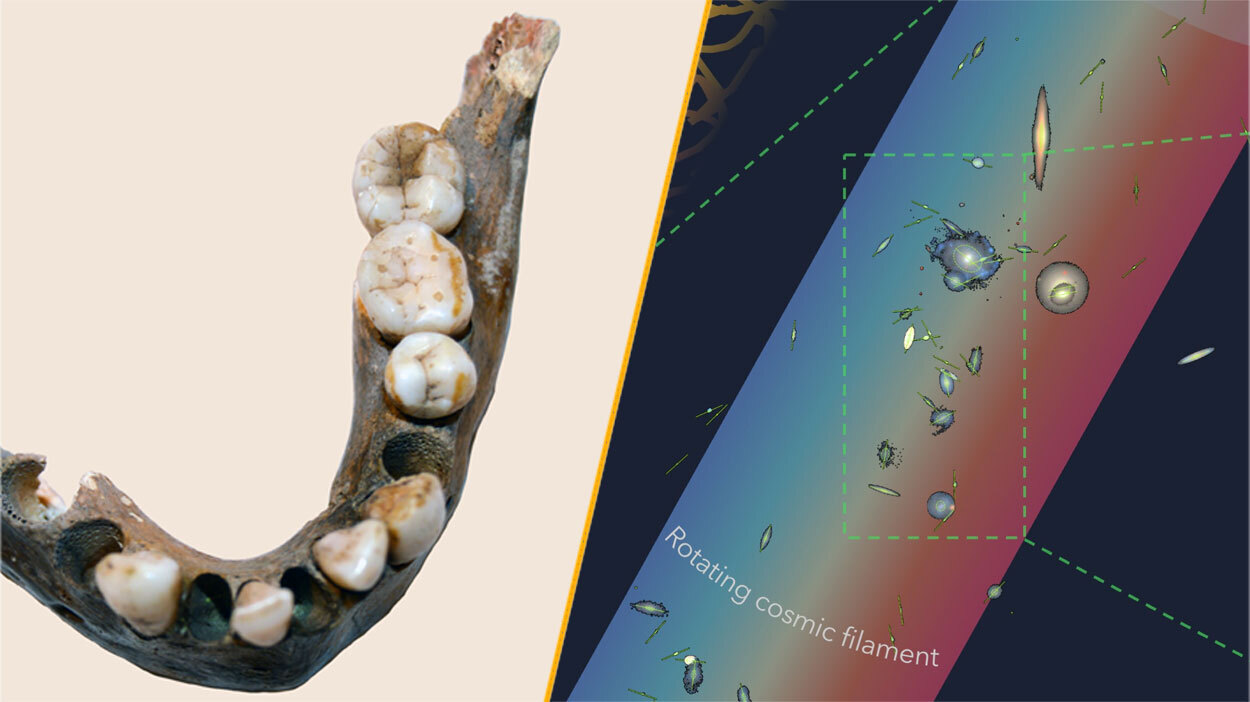 Science news this week: A human population isolated for 100,000 years, the biggest spinning structure in the universe, and a pit full of skulls
LATEST ARTICLES
Science news this week: A human population isolated for 100,000 years, the biggest spinning structure in the universe, and a pit full of skulls
LATEST ARTICLES- 1Ethereal structure in the sky rivals 'Pillars of Creation' — Space photo of the week
- 2What was the loudest sound ever recorded?
- 3New 3I/ATLAS images show the comet getting active ahead of close encounter with Earth
- 4Unusual, 1,400-year-old cube-shaped human skull unearthed in Mexico
- 51,800-year-old 'piggy banks' full of Roman-era coins unearthed in French village
