- Home
Edition
Africa Australia Brasil Canada Canada (français) España Europe France Global Indonesia New Zealand United Kingdom United States Edition:
Global
Edition:
Global
- Africa
- Australia
- Brasil
- Canada
- Canada (français)
- España
- Europe
- France
- Indonesia
- New Zealand
- United Kingdom
- United States
Academic rigour, journalistic flair
 Vagengeim/Shutterstock.com
Aluminium in vaccines: separating RFK Jr’s claims from scientific evidence
Published: December 4, 2025 4.27pm GMT
Antony Black, University of Westminster
Vagengeim/Shutterstock.com
Aluminium in vaccines: separating RFK Jr’s claims from scientific evidence
Published: December 4, 2025 4.27pm GMT
Antony Black, University of Westminster
Author
-
 Antony Black
Lecturer, Life Sciences, University of Westminster
Disclosure statement
Antony Black does not work for, consult, own shares in or receive funding from any company or organisation that would benefit from this article, and has disclosed no relevant affiliations beyond their academic appointment.
Partners

University of Westminster provides funding as a member of The Conversation UK.
View all partners
DOI
https://doi.org/10.64628/AB.jnfusxpt5
https://theconversation.com/aluminium-in-vaccines-separating-rfk-jrs-claims-from-scientific-evidence-270601 https://theconversation.com/aluminium-in-vaccines-separating-rfk-jrs-claims-from-scientific-evidence-270601 Link copied Share articleShare article
Copy link Email Bluesky Facebook WhatsApp Messenger LinkedIn X (Twitter)Print article
The US health secretary, Robert F. Kennedy Jr, believes that aluminium in vaccines can cause health issues, such as neurological disorders, allergies and autoimmune diseases. This contradicts scientific evidence from many studies that have confirmed the safety of vaccines and aluminium “adjuvants” – substances that boost vaccines’ effectiveness.
In November 2025, RFK Jr “personally ordered” the US Centers for Disease Control and Prevention (CDC) to alter its webpage on autism and vaccines, with several sections now casting doubt on vaccine safety. For example, where it previously stated that “studies have shown there is no link between receiving vaccines and developing autism spectrum disorder”, it now reads “‘vaccines do not cause autism’ is not an evidence-based claim”.
To write this on a public-facing website represents an about-turn for the CDC, whose advice is often sought by people looking for clarity and guidance. It also feeds into the anti-vaccine narrative that is opposed by most scientists.
Pressurising the CDC represents only one of RFK Jr’s strategies to undermine the public’s trust in vaccines. This is extremely concerning, given the influence that he holds in his current position, and the effect this will have on vaccine policy, demand, manufacturing and, ultimately, the spread of infectious diseases.
Adjuvants are a key addition to vaccines and help to increase the body’s response to vaccination, enhancing the level of protection that the recipient gains. Without adjuvants, many vaccines simply wouldn’t work or would provide only short-lasting protection.
Aluminium salts, such as aluminium sulphate and aluminium hydroxide, have been used as adjuvants for almost a century. They are a key component in several vaccines, including those that protect against hepatitis B, diphtheria, tetanus and human papillomavirus. They have enhanced hundreds of millions of vaccine doses worldwide, which saves millions of lives annually.
Read more: Adjuvants: the unsung heroes of vaccines
We are all exposed to aluminium daily in food, water, soil and, for babies, in breast milk. For example, some processed cheese contains up to 15mg per slice. Aluminium ingested in this manner enters the bloodstream and is filtered out via the kidneys. Aluminium salts in vaccines (between 0.25 and 1.2mg of aluminium) also enter the bloodstream and are removed from the body in the same manner.
Studies have shown that the amounts of aluminium that enter the body after vaccination are extremely small, pose no risk of toxicity, and the amount of aluminium in the body is not linked to how many vaccines you’ve had.
A recent study from Denmark examined aluminium exposure in the first two years of life in over 1 million children. This study confirmed that there is no link between exposure and any of 50 diseases that were looked at, including autism.
But what about the other claims – such as the purported link to autoimmune disease?
Autoimmunity is an umbrella term encompassing a broad spectrum of diseases where the body’s immune system attacks itself. Some people have claimed that vaccines can induce autoimmunity. However, studies in vaccine recipients have shown convincing evidence that this is not the case.
Similarly, it is thought highly unlikely that vaccines cause asthma, allergies or other serious harms. Vaccine safety is thoroughly evaluated before any vaccine is approved, and safety monitoring continues for all vaccines after they become available.
Still, it is apparent that diagnoses of autism, asthma and allergies are on the rise. If vaccines are not the reason, then what is?
Too clean?
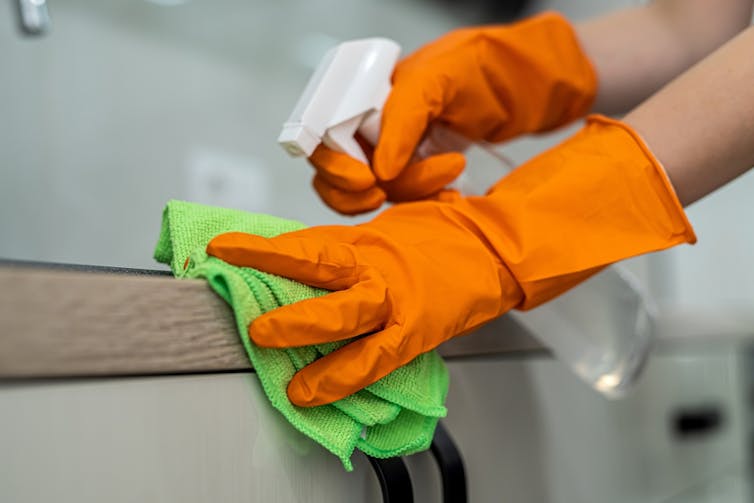
One idea that has been proposed is the “hygiene hypothesis”. It suggests that society has become too clean. As such, lack of exposure to many germs during childhood may deprive the immune system of essential “training” and therefore it reacts excessively to otherwise harmless particles, such as pollen, dust and nuts.
 The hygiene hypothesis is one explanation for the rise in allergies.
RomanR/Shutterstock.com
The hygiene hypothesis is one explanation for the rise in allergies.
RomanR/Shutterstock.com
Other factors probably also play a role, including improved detection and diagnosis, environmental and prenatal influences, and, in the case of asthma, increased air pollution.
Increasing vaccine hesitancy and reduced vaccination rates lead to more vulnerable people and more infectious diseases, illnesses and deaths. It is important to question medical interventions, but this questioning should be informed, rational and open.
Vaccines remain one of the most cost-effective, safe and important public health interventions – and we undermine public trust in vaccines at our peril.
- Vaccines
- Anti-vaxxers
- Give me perspective
- Robert F Kennedy Jr
- US CDC
Events
Jobs
-
 Respect and Safety Project Manager
-
Associate Dean, School of Information Technology and Creative Computing | SAE University College
-
Senior Lecturer, Clinical Psychology
-
University Lecturer in Early Childhood Education
-
Case Specialist, Student Information and Regulatory Reporting
 Respect and Safety Project Manager
 Associate Dean, School of Information Technology and Creative Computing | SAE University College
 Senior Lecturer, Clinical Psychology
 University Lecturer in Early Childhood Education
 Case Specialist, Student Information and Regulatory Reporting
- Editorial Policies
- Community standards
- Republishing guidelines
- Analytics
- Our feeds
- Get newsletter
- Who we are
- Our charter
- Our team
- Partners and funders
- Resource for media
- Contact us
-
-
-
-
Copyright © 2010–2025, The Conversation