
- Home
Edition
Africa Australia Brasil Canada Canada (français) España Europe France Global Indonesia New Zealand United Kingdom United States Edition:
Global
Edition:
Global
- Africa
- Australia
- Brasil
- Canada
- Canada (français)
- España
- Europe
- France
- Indonesia
- New Zealand
- United Kingdom
- United States
Academic rigour, journalistic flair
 The Alberta Fairness and Safety in Sport Act (Bill 29) bans transgender girls aged 12 years and older from participating in female-only competitive sports divisions.
(Unsplash)
Fairness for whom? The impact of Alberta’s trans-exclusionary sports law
Published: December 4, 2025 5.33pm GMT
Gio Dolcecore, Celeste Pang, Mount Royal University
The Alberta Fairness and Safety in Sport Act (Bill 29) bans transgender girls aged 12 years and older from participating in female-only competitive sports divisions.
(Unsplash)
Fairness for whom? The impact of Alberta’s trans-exclusionary sports law
Published: December 4, 2025 5.33pm GMT
Gio Dolcecore, Celeste Pang, Mount Royal University
Authors
-
 Gio Dolcecore
Assistant Professor, Social Work, Mount Royal University
-
Celeste Pang
Assistant Professor, Women's and Gender Studies, Mount Royal University
Disclosure statement
The authors do not work for, consult, own shares in or receive funding from any company or organisation that would benefit from this article, and have disclosed no relevant affiliations beyond their academic appointment.
Partners

Mount Royal University provides funding as a member of The Conversation CA.
Mount Royal University provides funding as a member of The Conversation CA-FR.
View all partners
DOI
https://doi.org/10.64628/AAM.p7pquspgm
https://theconversation.com/fairness-for-whom-the-impact-of-albertas-trans-exclusionary-sports-law-265565 https://theconversation.com/fairness-for-whom-the-impact-of-albertas-trans-exclusionary-sports-law-265565 Link copied Share articleShare article
Copy link Email Bluesky Facebook WhatsApp Messenger LinkedIn X (Twitter)Print article
Alberta’s Fairness and Safety in Sport Act promises protection. We believe that it discriminates and decides who gets to belong in sport.
The act, which received royal assent in December 2024 and came into effect on Sept. 1, 2025, requires organizations like school divisions, post-secondary institutions and provincial sport bodies to create and implement policies for athlete eligibility, including limiting eligibility for female-only divisions to people assigned female at birth.
While framed by the province’s United Conservative Party government as a measure to protect competition and ensure athletes “are able to participate in the sports they love fairly, safely, and meaningfully,” the act bans transgender girls aged 12 years and older from participating in competitive sports for women.
As there is no consistent or conclusive scientific evidence to show that transgender athletes have an inherent advantage, the act appears to be part of an organized anti-trans backlash occurring across the country, and a broader targeting of transgender and gender-nonconforming athletes internationally.
Far from just a local or niche issue, the implementation of this act exposes inconsistencies in sport policy and raises urgent questions about how anti-trans politics are shaping access to sport.
The impact on youth
The Fairness and Safety in Sport Act empowers just about anyone to file a complaint related to an organizations’ eligibility determinations. Incidents like one in British Columbia in 2023 — a man attending a girls’ track and field meet demanded that a nine-year-old cisgender girl with a pixie cut prove she was not a boy through documentation — demonstrate the impact of this type of gender policing.
The consequences fall on transgender and gender non-conforming youth. For them, being banned from participation brings not only the loss of athletic opportunities, but also heightened experiences of exclusion and stigma.
Teammates and coaches must also navigate fractured team dynamics and a school-based athletic culture that risks becoming less about belonging and more about surveillance. The policy undermines the very developmental and educational values that sport is meant to cultivate.
It also places heavy and often invisible demands on the people who support these children. Parents and caregivers are left to shoulder the emotional work of helping their children process the psychological repercussions of exclusion in ways that surpass the normal responsibilities of parenting.
Research consistently shows that parents of transgender and gender-diverse children face significantly elevated levels of stress compared to parents of non-transgender children. This is largely due to the chronic strain of stigma, discrimination and navigating hostile environments along with the emotional labour of advocating within schools, health care and peer groups.
The impact on society
The act also has implications for varsity athletics and broader sporting cultures at post-secondary institutions.
Universities across the province have been forced to create new internal policies and procedures to align with the act, which place incoming and existing athletes participating in women’s varsity sport under increased scrutiny.
An inconsistency emerges when Alberta athletes step onto fields, rinks and courts outside the province.
Since the national institution for post-secondary sport in Canada (U Sport) still allows transgender athletes to compete according to their gender identity, Alberta now risks excluding its own youth while requiring them to compete under different eligibility standards when facing athletes from other provinces.
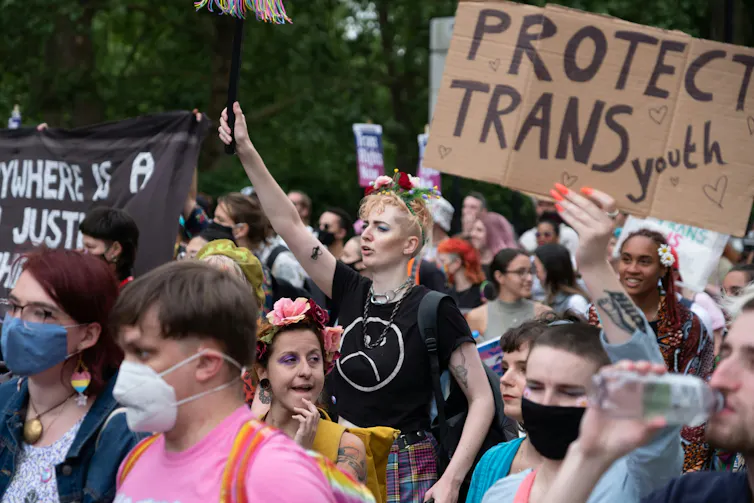 The consequences of Alberta’s Fairness and Safety in Sport Act fall heavily on transgender and gender non-conforming youth. Being banned from participation heightens experiences of exclusion and stigma.
(Unsplash)
The consequences of Alberta’s Fairness and Safety in Sport Act fall heavily on transgender and gender non-conforming youth. Being banned from participation heightens experiences of exclusion and stigma.
(Unsplash)
In addition, implementing this act will eventually create financial strain for organizations. Administering exclusionary rules requires new systems of eligibility verification, monitoring and appeals — an administrative burden that smaller leagues in particular are ill-equipped to manage.
A 2024 statement by the Alberta 2SLGBTQI+ Chamber of Commerce even urged the government to reject this trans-exclusionary legislation on the basis that it would also reduce Alberta’s market share of tourism and 2SLGBTQI+ travel revenue.
Resistance is necessary
Public response so far to the Fairness and Safety in Sport Act has been mixed.
Since it’s provincial law, school districts and universities have complied, creating internal policies and processes to fulfil the requirements of the act even while its trans-exclusionary nature runs counter to many of their values and commitments to equity, diversity and inclusion.
Some, however, have taken action. One University of Lethbridge faculty member, for example, resigned from the Board of Governors after it was forced to accept the new act.
Egale Canada, a national 2SLGBTQI organization — which, along with Calgary-based non-profit support organization Skipping Stone — has launched legal action against the Alberta government, challenging the constitutionality of the province’s anti-trans laws, and released a statement condemning the Fairness and Safety in Sport Act.
On Nov. 17, the Alberta government tabled legislation that seeks to invoke the notwithstanding clause of the Charter of Rights and Freedoms to insulate its laws from legal challenges. Using the clause would prevent courts from striking down laws for being unconstitutional, and in this context specifically, overrides the Charter rights of gender-diverse people.
This action has spurred widespread condemnation, including from the Canadian Civil Liberties Association and the Alberta Medical Association. Albertans are also making their views heard through MLA recall petitions and public protests.
The human toll of the Fairness and Safety in Sport Act must be recognized and challenged. When people refuse to accept exclusion and the overriding of basic human rights in sport, it can become a space for play, belonging and personal growth.
- Sport
- Transgender
- Alberta
- Women and girls
- United Conservative Party
- DEI
Events
Jobs
-
 Respect and Safety Project Manager
-
Associate Dean, School of Information Technology and Creative Computing | SAE University College
-
Senior Lecturer, Clinical Psychology
-
University Lecturer in Early Childhood Education
-
Case Specialist, Student Information and Regulatory Reporting
 Respect and Safety Project Manager
 Associate Dean, School of Information Technology and Creative Computing | SAE University College
 Senior Lecturer, Clinical Psychology
 University Lecturer in Early Childhood Education
 Case Specialist, Student Information and Regulatory Reporting
- Editorial Policies
- Community standards
- Republishing guidelines
- Analytics
- Our feeds
- Get newsletter
- Who we are
- Our charter
- Our team
- Partners and funders
- Resource for media
- Contact us
-
-
-
-
Copyright © 2010–2025, The Conversation

