- Home
Edition
Africa Australia Brasil Canada Canada (français) España Europe France Global Indonesia New Zealand United Kingdom United States Edition:
Global
Edition:
Global
- Africa
- Australia
- Brasil
- Canada
- Canada (français)
- España
- Europe
- France
- Indonesia
- New Zealand
- United Kingdom
- United States
Academic rigour, journalistic flair
 Nick Fewings/Unsplash
Storms in the Southern Ocean are producing more rain – and the consequences could be global
Published: December 4, 2025 11.45pm GMT
Steven Siems, Zhaoyang Kong, Monash University
Nick Fewings/Unsplash
Storms in the Southern Ocean are producing more rain – and the consequences could be global
Published: December 4, 2025 11.45pm GMT
Steven Siems, Zhaoyang Kong, Monash University
Authors
-
 Steven Siems
Professor in Cloud Microphysics, Monash University
-
Zhaoyang Kong
PhD Candidate, School of Earth, Atmosphere and Environment, Monash University
Disclosure statement
Steven Siems receives funding from the Australian Research Council.
Zhaoyang Kong does not work for, consult, own shares in or receive funding from any company or organisation that would benefit from this article, and has disclosed no relevant affiliations beyond their academic appointment.
Partners

Monash University provides funding as a founding partner of The Conversation AU.
View all partners
DOI
https://doi.org/10.64628/AA.h9h6tvn3p
https://theconversation.com/storms-in-the-southern-ocean-are-producing-more-rain-and-the-consequences-could-be-global-270880 https://theconversation.com/storms-in-the-southern-ocean-are-producing-more-rain-and-the-consequences-could-be-global-270880 Link copied Share articleShare article
Copy link Email Bluesky Facebook WhatsApp Messenger LinkedIn X (Twitter)Print article
If you ever find yourself on Macquarie Island – a narrow, wind-lashed ridge halfway between Tasmania and Antarctica – the first thing you’ll notice is the wildlife. Elephant seals sprawl across dark beaches. King penguins march up mossy slopes. Albatrosses circle over vast, treeless uplands.
But look more closely and the island is changing. Slopes are becoming boggier. Iconic megaherbs such as Pleurophyllum and Stilbocarpa are retreating.
For years, scientists suspected the culprit was increasing rainfall. Our new research, published in Weather and Climate Dynamics, confirms this – and shows the story goes far beyond one remote UNESCO World Heritage site.
A major – but little observed – climate player
The Southern Ocean plays an enormous role in the global climate system.
It absorbs much of the excess heat trapped by greenhouse gases and a large share of the carbon dioxide emitted by human activity.
Storms in the Southern Ocean also influence weather patterns across Australia, New Zealand and the globe.
Yet it is also one of the least observed places on Earth.
With almost no land masses, only a handful of weather stations, and ubiquitous cloud cover, satellites and simulations struggle to capture what is actually happening there.
That makes Macquarie Island’s climate record from the Bureau of Meteorology and the Australian Antarctic Division exceptionally valuable, providing one of the very few long-term “ground truth” records anywhere in the Southern Ocean.
These high-quality records of the observed daily rainfall and meteorology date back more than 75 years and are commonly used to validate satellite products and numerical simulations.
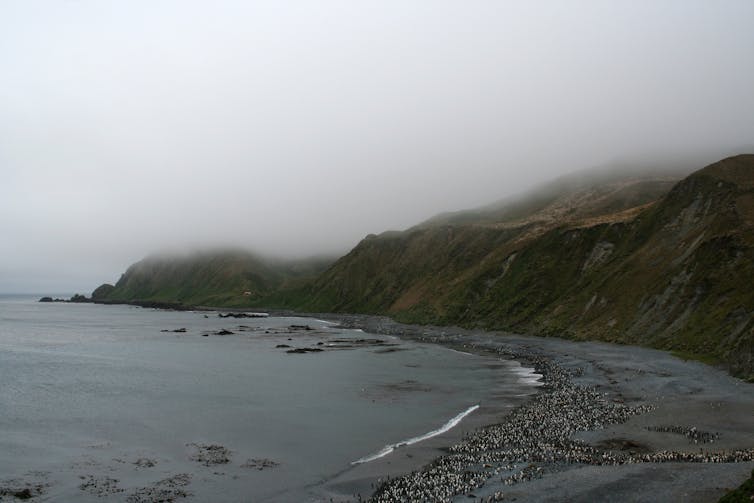 Macquarie Island is a tiny speck of land in the Southern Ocean.
David Killick/AP
Macquarie Island is a tiny speck of land in the Southern Ocean.
David Killick/AP
Rising rainfall
Earlier work has found rainfall at Macquarie Island had risen sharply over recent decades, and ecologists documented waterlogging that harms native vegetation.
But no one has explained how the island’s weather patterns are changing, or directly compared the field observations to our best reconstructions of past weather to assess Southern Ocean climate trends.
To fill this gap, we analysed 45 years (1979–2023) of daily rainfall observations and compared them to a widely used reconstruction of earlier weather, known as the ERA5 reanalysis.
We wanted to understand the meteorology behind the increase in rainfall – that is, whether it was caused by more storms or more intense rainfall during storms. To do this we placed each day in the dataset into one of five synoptic regimes based on pressure, humidity, winds and temperature.
These regimes included low pressure systems, cold-air outbreaks and warm-air advection (the warm air that moves poleward ahead of a cold front).
Storms are producing more rain
Our analysis showed that annual rainfall on Macquarie Island has increased 28% since 1979 – around 260 millimetres per year.
The ERA5 reanalysis, in contrast, shows only an 8% increase — missing most of this change.
The storm track’s gradual move toward Antarctica is well established, and our results show how this larger change is shaping Macquarie Island’s weather today.
Crucially, we found that these changes are not causing the increase in rainfall, as one wet regime (warm air advection) was largely replacing another (low pressure).
Instead, storms now produce more rain when they occur.
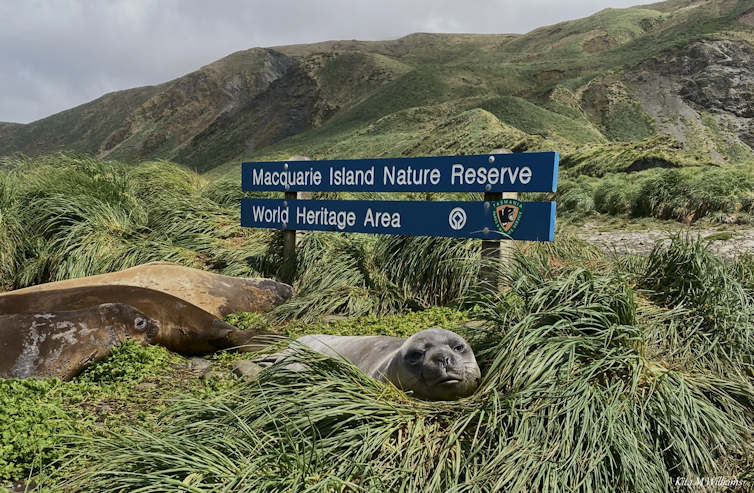 Elephant seals on Macquarie Island.
Kita Williams
Elephant seals on Macquarie Island.
Kita Williams
Why does this matter beyond one island?
If the rainfall intensification we see at Macquarie Island reflects conditions across the Southern Ocean storm belt – as multiple lines of evidence indicate — the consequences are profound.
A wetter storm track means more fresh water entering the upper ocean. This strengthens the different layers in the oceans and reduces the amount of mixing that occurs. In turn, this alters the strength of ocean currents.
Our estimate suggests that in 2023 this additional precipitation equates to roughly 2,300 gigatonnes of additional freshwater per year across the high-latitude Southern Ocean – an order of magnitude greater than recent Antarctic meltwater contributions. And this difference continues to grow.
More rainfall will also affect the salinity of water on the ocean’s surface, which influences the movement of nutrients and carbon. As a result, this could change the productivity and chemistry of the Southern Ocean – one of the world’s most important carbon sinks – in still-uncertain ways.
This increase in rainfall requires a matching increase in evaporation, which cools the ocean, just like our bodies cool when our sweat evaporates. Over the cloudy Southern Ocean, this evaporation is the primary means of cooling the ocean.
Our analysis indicates the Southern Ocean may be cooling itself by 10–15% more than it did in 1979 – simply through the energy cost of evaporation that fuels the extra rainfall. This evaporation is spread over the broader Southern Ocean.
In effect, the Southern Ocean may be “sweating” more in response to climate change.
The next challenge
Macquarie Island is just one tiny speck of land in Earth’s stormiest ocean.
But its long-term rainfall record suggests the Southern Ocean – the engine room of global heat and carbon uptake – is changing faster and more dramatically than we thought.
The next challenge is to determine how far this signal extends across the storm track, and what it means for the climate system we all depend on.
The authors would like the acknowledge Andrew Prata, Yi Huang, Ariaan Purish and Peter May for their contribution to the research and this article.
- Climate change
- Rainfall
- Southern ocean
- Storms
- Macquarie Island
- New research
Events
Jobs
-
 Respect and Safety Project Manager
-
Associate Dean, School of Information Technology and Creative Computing | SAE University College
-
Senior Lecturer, Clinical Psychology
-
University Lecturer in Early Childhood Education
-
Case Specialist, Student Information and Regulatory Reporting
 Respect and Safety Project Manager
 Associate Dean, School of Information Technology and Creative Computing | SAE University College
 Senior Lecturer, Clinical Psychology
 University Lecturer in Early Childhood Education
 Case Specialist, Student Information and Regulatory Reporting
- Editorial Policies
- Community standards
- Republishing guidelines
- Analytics
- Our feeds
- Get newsletter
- Who we are
- Our charter
- Our team
- Partners and funders
- Resource for media
- Contact us
-
-
-
-
Copyright © 2010–2025, The Conversation

